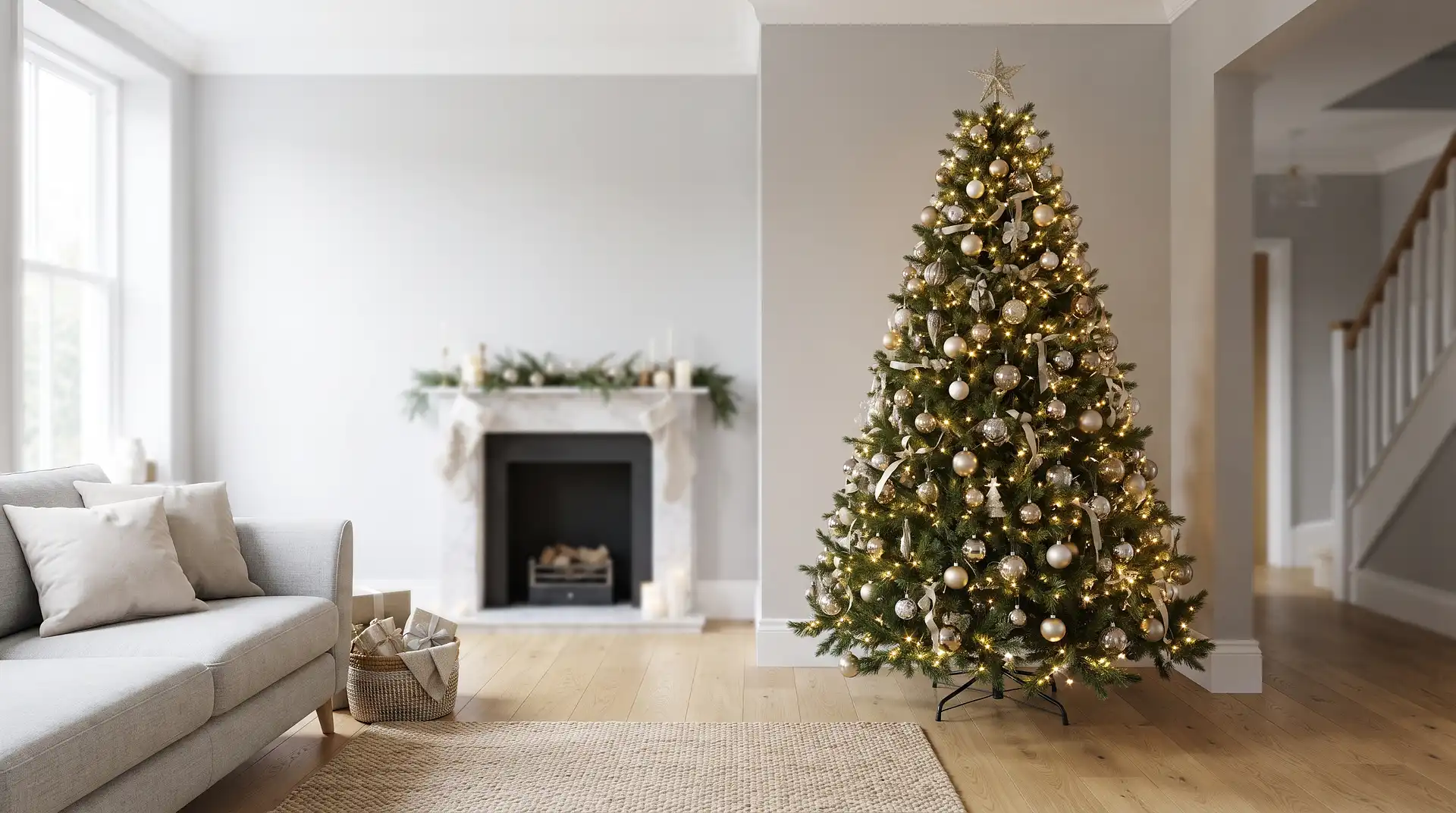
How Many Christmas Lights Do I Need? (By Tree Height)
22 September 2026
How Many Christmas Lights Do I Need? (By Tree Height)
The standard rule for lighting a Christmas tree is roughly 100 lights per foot of tree height for a well-covered, traditional look, meaning a 7ft tree needs approximately 700 lights, while a smaller 4ft tree needs around 400 and a larger 9ft tree needs around 900. This formula scales cleanly across the common range of UK tree heights, which is more useful than a single figure for one specific size, since trees genuinely vary and the same underlying rule applies whether you're lighting a small tabletop tree or a large statement piece in a hallway.
The 100-lights-per-foot guideline assumes a fairly full, evenly distributed traditional look. If you prefer a sparser, more minimal style, you can comfortably reduce this, and if you want a denser, more dramatic look with lights wrapped deep into the branches rather than just around the outer tips, you'll want to increase it.
The Formula and Full Size Table
Tree Height | Lights Needed (Standard Coverage) | Lights Needed (Dense Coverage) |
|---|---|---|
4ft | 350–400 | 500–600 |
5ft | 450–500 | 650–750 |
6ft | 550–650 | 800–900 |
7ft | 650–750 | 950–1,050 |
8ft | 750–850 | 1,100–1,200 |
9ft | 850–950 | 1,250–1,350 |
10ft | 950–1,100 | 1,400–1,550 |
12ft | 1,150–1,300 | 1,700–1,900 |
Why the Formula Isn't Perfectly Linear
You'll notice the per-foot ratio drops slightly as trees get taller, roughly 100 lights per foot at the smaller end, closer to 90 to 95 per foot for very tall trees. This is because taller trees are also typically wider and bushier in proportion, but the visual density needed to look "well-lit" doesn't need to scale in perfect proportion the way pure surface area might suggest, since the eye reads an evenly spaced string as sufficiently bright even with a slightly lower ratio on a genuinely large tree.
How to Measure Your Tree Correctly
Measure your tree's actual height from the base to the top tip, not including any stand, star, or topper, since these aren't part of the branch structure you're actually lighting. For an artificial tree, this figure is usually listed on the packaging or product page, while a real tree needs measuring directly with a tape measure once it's set up in its final position.
Accounting for Tree Fullness
A slim or "pencil" style tree needs somewhat fewer lights than the standard formula suggests for its height, since there's simply less branch volume to cover. A very full, bushy tree, or one with multiple thick tiers of branches, may need lights toward the higher end of the range, or even beyond it, to achieve genuinely even coverage rather than looking sparse despite technically following the standard formula.
How to Distribute Lights Evenly
Working from the top of the tree downward, wrap lights around branches in a spiral or in-and-out pattern reaching toward the trunk rather than only draping them across the outer tips. This "in and out" technique, pushing the light string deeper into the branch structure and back out, creates a more three-dimensional, professionally lit look than lights that sit purely on the surface.
A Note on Combining Multiple Light Sets
Since a 7ft tree needing 700 lights typically means connecting multiple standard light sets together, always check the manufacturer's stated maximum number of sets that can be safely daisy-chained end to end, since exceeding this limit overloads the cable in the first set and creates a genuine fire risk. For a large total light count, plugging separate strings into different sockets around the tree, rather than chaining an excessive number end to end, is the safer approach.
A Note on LED vs Incandescent Light Counts
LED light sets often come with more bulbs per string than traditional incandescent sets at a similar price point, and since LEDs run considerably cooler and use less energy, you can generally use the full recommended count without the heat or energy consumption concerns that once made people deliberately under-light a tree with older incandescent bulbs.
When to Call a Professional
Lighting a tree is very much a DIY task, but if you're planning a genuinely large, multi-tree, or whole-house festive lighting display, particularly anything involving permanent wiring or a display run from multiple circuits, an electrician can advise on safe circuit loading and, for a permanent seasonal setup used every year, whether a dedicated outdoor circuit is worth installing.
Use InstantCost's electrician cost calculator to see what additional socket points or circuit work would cost if you're planning a larger, more permanent lighting setup. If you're decorating the outside of the house as well as a tree, how to hang Christmas lights on the house covers the safety considerations specific to outdoor decorating.
Common Mistakes and What to Do Instead
Mistake: Guessing the light count rather than calculating it from tree height. This often results in a tree that looks noticeably underlit compared with the intended look. Use the per-foot formula and size table to get a realistic starting figure before buying.
Mistake: Not accounting for tree fullness or style. A slim pencil tree and a very full, bushy tree of the same height need meaningfully different light counts to look properly covered. Adjust up or down from the standard formula based on your specific tree's shape.
Mistake: Only wrapping lights around the outer tips of branches. This creates a flat, two-dimensional look. Push light strings in toward the trunk and back out along branches for a fuller, more professional appearance.
Mistake: Daisy-chaining more light sets than the manufacturer allows. With a large total light count for a taller tree, it's easy to exceed a manufacturer's stated safe connection limit. Check this limit and use separate sockets for additional strings rather than chaining beyond it.
Mistake: Buying incandescent lights out of habit without considering LED alternatives. LEDs run cooler, use less energy, and often come in longer strings, making it easier and safer to reach your full recommended light count for a larger tree.
Mistake: Not testing all lights before putting them on the tree. Discovering a faulty section after the tree is fully decorated means unwrapping and rewrapping lights unnecessarily. Test every string on the floor before starting to wrap the tree.
What It Costs in the UK
Item or Service | Typical UK Cost (2026) |
|---|---|
LED light string (100 lights) | £8–£18 |
LED light string (300 lights) | £18–£35 |
Full set for a 7ft tree (approx. 700 lights) | £45–£90 |
Full set for a 9ft tree (approx. 900 lights) | £60–£120 |
Timer plug | £6–£15 |
Electrician, additional socket install | £90–£150 |
Figures based on InstantCost.co.uk's 2026 UK electrician pricing data for related electrical work, combined with general UK retail pricing for seasonal LED lighting.
Staying Safe
Check every light string for damaged cables or bulbs before use, particularly sets that have been stored for a year or more, and never use a set showing cracked casing, exposed wire, or a burning smell. Always use lights and extensions genuinely rated for indoor use if the tree is inside, and outdoor-rated equipment for anything outside.
Use RCD protection for any tree lighting powered from an outdoor socket, and avoid overloading a single socket or extension lead with an excessive number of connected light sets. Use a timer plug so lights aren't left running unattended overnight.
General UK electrical safety guidance recommends checking decorative lighting for damage annually, avoiding overloaded sockets or extension leads, and never leaving decorative lighting unattended for extended periods.
Frequently Asked Questions
How many lights do I need for a 7ft Christmas tree? Approximately 650 to 750 lights for standard, well-covered coverage, or 950 to 1,050 for a denser, more dramatic look, based on the standard formula of roughly 100 lights per foot of tree height.
Does a fuller tree need more lights than a slim tree of the same height? Yes. A bushy, full tree has more branch volume to cover and typically needs lights toward the higher end of the range for its height, while a slim pencil-style tree can look well-lit with somewhat fewer.
Is 100 lights per foot always the right number? It's a widely used starting guideline for a traditional, evenly covered look, but personal preference varies considerably. Reduce it for a more minimal, sparse style, or increase it for a denser, more dramatic effect.
How many light sets can I safely connect together for a large tree? This depends on the specific manufacturer's guidance, so always check the packaging or instructions, but exceeding the stated limit risks overloading the first set's cable. Use separate sockets for additional strings once you reach that connection limit.
Should I measure my tree including the topper or star? No, measure only the tree itself from base to top tip, excluding any topper, star, or stand, since the formula is based on the branch structure you're actually lighting.
Are LED lights better than incandescent for a large tree? Generally yes, since LEDs run cooler, use considerably less energy, and often come in longer strings, making it more practical and safer to reach the higher light counts a larger tree needs.