How to Adjust a Kitchen Cupboard Door
29 September 2026
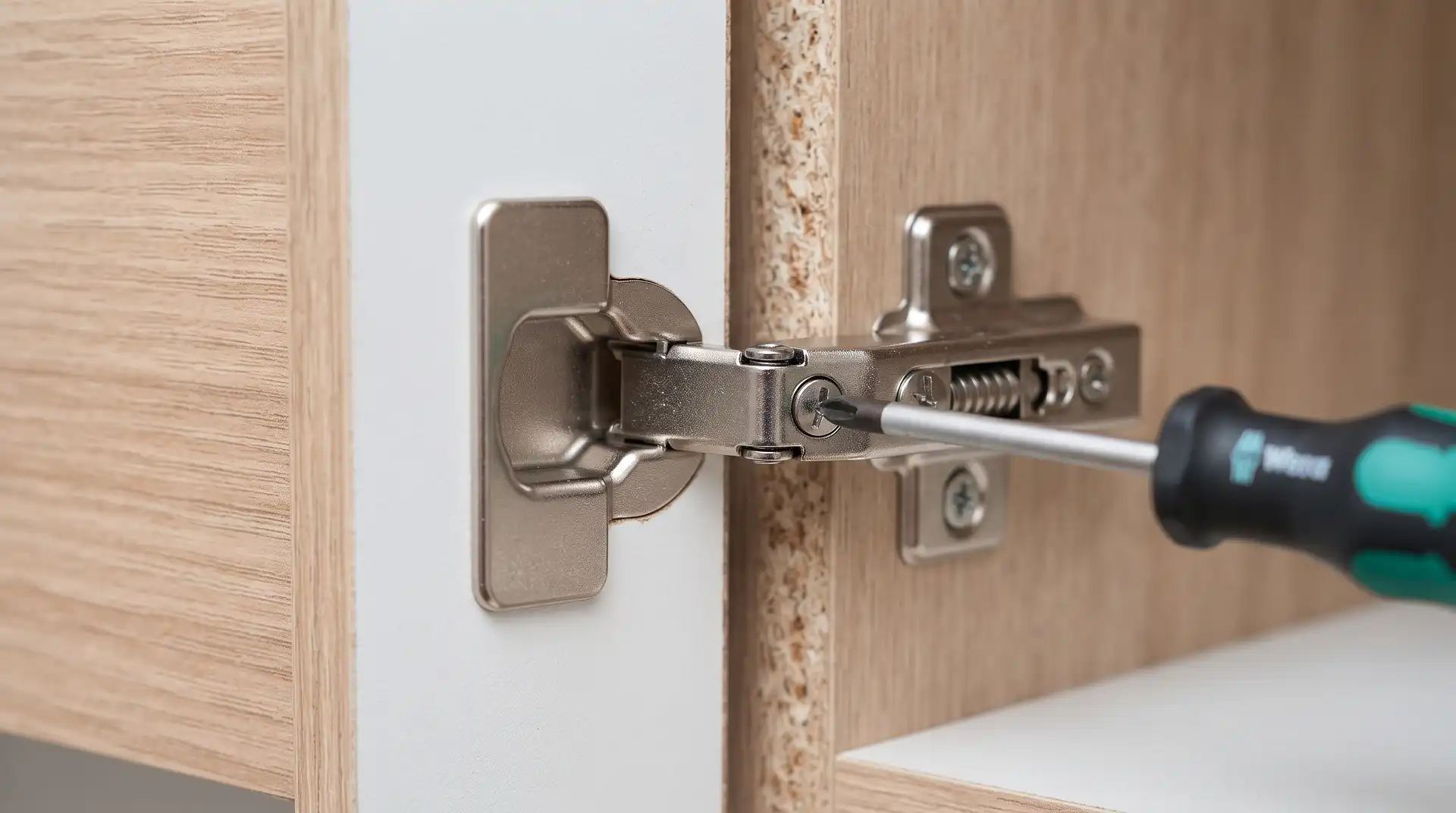
Most kitchen cupboard doors can be adjusted using a crosshead screwdriver. Modern concealed hinges normally allow you to move the door up or down, left or right, and closer to or further away from the cabinet.
Before turning any screws, look at the closed door and identify the exact problem. Make small adjustments of about a quarter turn, close the door and check the result before continuing.
Quick answer: Use the mounting plate screws to adjust the door height, the side adjustment screw to change the gap between doors and the depth screw to move the door closer to or further from the cabinet. Adjust both hinges equally to move the whole door, or adjust one hinge to correct a tilted door.
How Kitchen Cupboard Hinges Work
Most modern UK kitchens use concealed hinges, sometimes called European or Euro hinges. The hinge sits inside the cupboard when the door is closed.
A standard concealed hinge has two main parts:
Hinge cup: The round section fitted into the back of the cupboard door
Mounting plate: The section fixed to the inside wall of the cabinet
The metal arm joining these parts normally contains the adjustment controls. Although hinge designs vary, most provide three types of adjustment.
Adjustment | What it changes | When to use it |
|---|---|---|
Height | Moves the complete door up or down | The top or bottom edge does not line up with nearby doors |
Side | Moves the door left or right | The gap is uneven or two doors touch |
Depth | Moves the door in or out | The door sits proud, catches or will not close properly |
Identify the Screws Before Adjusting the Door
Open the cupboard door fully and inspect both hinges. Do not assume that every visible screw is an adjustment screw.
Mounting plate screws
The mounting plate is fixed to the cabinet side with two screws. On many hinges, loosening these screws slightly allows the complete door to slide up or down.
Some newer hinges use a separate height-adjustment cam instead. Check the hinge manufacturer's instructions if the mounting plate does not slide.
Side adjustment screw
The side adjustment screw is usually positioned towards the front of the hinge arm, closer to the door. Turning it changes how much the door overlaps the cabinet edge.
The direction of movement can vary with the hinge design and the side on which it is fitted. Turn the screw by a quarter turn and watch which way the door moves.
Depth adjustment screw
The depth screw is normally located further back on the hinge arm, closer to the inside of the cabinet. It controls how close the door sits to the cabinet when closed.
Hinge cup screws
The screws inside the door hold the round hinge cup in place. They are not normally used for alignment. Check that they are secure, but do not remove them unless you are replacing the hinge.
Important: Hinge designs differ. If turning a screw does not create the expected movement, return it to its original position and identify its function before continuing.
What You Will Need
A manual crosshead screwdriver
A flat screwdriver if required by the hinge
A small spirit level
A tape measure or ruler
Masking tape for marking the original position
Someone to support a large or heavy door
A manual screwdriver gives better control than a drill driver. Power tools can overtighten the screws and strip the chipboard cabinet or damage the hinge mechanism.
Check the Cabinet Before Adjusting the Door
Hinge adjustment cannot correct every alignment problem. Before changing the hinges, check that:
The cabinet is level and square
The cabinet is securely fixed to the wall
The worktop is not forcing the cabinet out of shape
All hinge screws are present
The hinge arm is clipped onto the mounting plate correctly
The door is not visibly warped
No item inside the cupboard is preventing it from closing
If several doors on the same run slope in the same direction, the cabinets may not be level. Adjusting every hinge may hide the problem temporarily, but the doors can move out of alignment again.
How to Adjust a Kitchen Cupboard Door Step by Step
1. Tighten loose fixing screws
Support the door with one hand and gently tighten the screws fixing the hinge cup to the door and the mounting plate to the cabinet.
Do not overtighten them. If a screw keeps turning without becoming secure, its fixing hole may be damaged.
2. Close the door and inspect the gaps
Look at the top, bottom and side gaps. Compare the door with neighbouring doors and drawers.
Use small pieces of masking tape to mark the corners that need to move. This prevents confusion when the door is open.
3. Adjust the height first
Support the weight of the door. Loosen the mounting plate screws on every hinge just enough to allow movement.
Move the complete door up or down until its top and bottom edges line up with the neighbouring units. Hold it in position and retighten the screws gradually.
For a tall door with three hinges, loosen all three mounting plates before moving it. Do not try to force the height by moving only one hinge.
4. Adjust the depth
Close the door and check whether it sits level with the surrounding doors. If one corner sticks out, use the depth adjustment on the nearest hinge.
Adjust both hinges by the same amount when the whole door needs to move in or out. Adjust only one hinge when correcting a twist.
Leave enough clearance for the door to open without rubbing against the cabinet edge.
5. Adjust the side position
Use the side adjustment screw to change the gap between the door and the cabinet or between a pair of doors.
Turn the screw by a quarter turn, close the door and inspect the gap. Continue in small stages until the gap is even.
If the entire door needs to move sideways, adjust the top and bottom hinges by the same amount.
6. Correct a tilted door
If the door is level on one side but slopes across the top, adjust the side screw on one hinge at a time.
For example, move the top corner without moving the bottom corner. If more correction is needed, make a small opposite adjustment at the lower hinge.
Keep closing the door between adjustments. A small movement at the hinge can create a noticeable change at the far edge of the door.
7. Make the final checks
Open and close the door several times. Check that it:
Opens without rubbing
Closes without being pushed
Sits level with nearby doors
Has an even gap around its edges
Does not hit a handle on the neighbouring unit
Does not spring open again
Best adjustment order: Set the height first, adjust the depth second and finish with the side gaps. Changing the height after setting the gaps can undo your earlier work.
How to Fix a Sagging Cupboard Door
A sagging door normally has a larger gap at the top near the handle and a smaller gap at the bottom. It may also catch on the cabinet or the door beside it.
Start by checking for loose hinge and mounting plate screws. If the fixings are secure, use the side adjustment screw on the top hinge to move the upper outside corner back into position.
Make a smaller opposite adjustment at the bottom hinge if needed. Do not wind one adjustment screw fully in or out because concealed hinges have a limited range.
How to Align Two Cupboard Doors
Stand directly in front of the cabinet and inspect the centre gap.
If the gap is too narrow
Move each door slightly towards its own hinge side. Divide the adjustment between both doors so they remain centred over the cabinet.
If the gap is too wide
Move each door slightly towards the centre. Check that the handle-side edges do not touch when opening.
If the gap is wider at the top
Adjust the top hinge on one or both doors towards the centre. A small change may be enough.
If the gap is wider at the bottom
Adjust the lower hinges towards the centre or make the opposite correction at the top.
Use neighbouring doors and drawer fronts as visual reference lines. A consistent gap is more important than forcing every measurement to be exactly identical.
How to Adjust a Door That Sits Too Far Forward
If the closed door projects beyond the surrounding doors, use the depth adjustment screw to move it closer to the cabinet.
Adjust the top and bottom hinges equally when the complete door sits forward. If only one corner is proud, adjust the closest hinge.
Check that the door does not rub against the cabinet when opened. Moving it too far in can cause the hinge-side edge to bind.
Why Will the Cupboard Door Not Close?
A door that will not stay closed is not always an alignment problem. Check for:
An item inside the cabinet pressing against the door
A loose shelf or internal drawer
A damaged soft-close mechanism
A bent hinge arm
A failed hinge spring
A warped door
A depth adjustment that is too tight
Two doors touching at the centre
Disconnect or switch off the soft-close mechanism temporarily if the hinge allows it. If the door closes normally without it, the soft-close unit may need adjustment or replacement.
How to Adjust Soft-Close Cupboard Hinges
Some soft-close hinges have a small switch or sliding control. This changes the amount of damping or turns the soft-close function off.
Use a lower setting for a small, lightweight door and a stronger setting for a large or heavy door. The controls may need to be set differently if the door has three hinges.
If the door slams despite adjustment, check whether the damper is damaged or the hinge spring has failed. Replacing the affected hinge may be more reliable than continuing to adjust it.
What If a Hinge Screw Will Not Tighten?
A screw that turns without gripping usually means the chipboard fixing hole has enlarged or broken.
Do not install a much longer screw without checking what lies behind the cabinet side. A long screw can break through the visible panel or interfere with an adjoining appliance.
Reliable repair options include:
A purpose-made cabinet hinge repair plate
A suitable chipboard repair plug
Moving the mounting plate where the hinge design permits it
Replacing a badly damaged cabinet side panel
A hinge repair plate spreads the load across a larger area and is often the simplest solution when the original fixing has pulled out.
Planning More Than a Door Adjustment?
Estimate the cost of new units, worktops, fitting and a complete kitchen update.
Calculate Your Kitchen Renovation Cost
When Adjustment Will Not Fix the Door
Hinge adjustment has a limited range. It will not correct:
A badly warped or swollen door
A bent or broken hinge
A cabinet that is loose or severely out of square
Incorrectly positioned hinge cup holes
A hinge fitted to the wrong type of door
Severe water damage around a sink or dishwasher
A cabinet side that can no longer hold the fixings
Lay a straight edge across the front and back of a suspected warped door. A visible gap or rocking movement indicates that the door itself is distorted.
Doors swollen by water should be checked for an active leak. Replacing or adjusting the hinge without stopping the moisture will not solve the underlying problem.
How Much Does Professional Cupboard Door Adjustment Cost?
InstantCost does not publish a separate fixed national price for adjusting one cupboard door. A kitchen fitter or handyman may apply a minimum visit charge even when the adjustment takes only a few minutes.
The closest matching InstantCost kitchen labour figures are:
Service | InstantCost 2026 price | Important detail |
|---|---|---|
Independent kitchen fitter | £25 to £45 per hour | A minimum call-out or visit charge may apply |
Kitchen fitter day rate | £150 to £350 | More relevant when several doors or units need repair |
Cosmetic kitchen refresh | £1,500 to £3,500 | May include repainting units, new handles and worktop refinishing |
For more information about labour charges and wider installation work, see our guide explaining how much it costs to fit a kitchen.
Safety Guidance
Support heavy doors before loosening hinges
Large cupboard, larder and integrated appliance doors can drop suddenly when mounting screws are loosened. Ask another person to hold the door or support it securely from underneath.
Use a screwdriver that fits the screw head properly. Stop if the tool slips repeatedly or the screw begins to round. Keep your free hand away from the screwdriver tip and the hinge mechanism.
If you use a drill driver, select a low torque setting and finish tightening by hand. The Health and Safety Executive advises that tools and work equipment should be maintained in safe working condition.
Keep fingers clear when testing a soft-close hinge. The spring mechanism can close suddenly and trap skin between the hinge arm and mounting plate.
Common Adjustment Mistakes
Turning several screws at once
Changing several controls makes it difficult to understand which movement helped. Adjust one control at a time and check the result.
Making large adjustments
Concealed hinges have a small adjustment range. Use quarter turns rather than winding a screw fully in or out.
Adjusting before tightening loose fixings
A loose mounting plate allows the door to move again. Secure the basic fixings before using the adjustment screws.
Using a drill at full torque
High torque can strip chipboard, damage the screw head or break the hinge mechanism. A manual screwdriver provides more control.
Trying to correct a warped door with the hinges
The hinges can correct small alignment errors but cannot pull a permanently bowed or twisted door flat.
Ignoring the cabinet level
If the cabinet is leaning or twisted, its doors cannot maintain even gaps. Check the units before repeatedly readjusting the hinges.
Frequently Asked Questions
Which screw adjusts the height of a cupboard door?
On many concealed hinges, the mounting plate screws control height. Loosen the plates on every hinge slightly, move the whole door up or down and retighten them. Some hinges have a separate height-adjustment cam.
Which screw moves a cupboard door left or right?
The side adjustment screw is usually on the hinge arm near the door. Turn it in small stages and observe the movement because the direction varies by hinge design and fitting side.
How do I stop two cupboard doors touching?
Use the side adjustment screws to move each door slightly away from the centre. Divide the adjustment between both doors to keep them centred over the cabinet.
Why does my cupboard door keep dropping?
The mounting plate screws may be loose or their holes may be damaged. Tighten secure fixings carefully. Use a hinge repair plate or suitable repair plug if the screws no longer grip.
Can soft-close hinges be adjusted?
Many soft-close hinges have a small switch or slider that changes the damping. If adjustment makes no difference, the damper or complete hinge may need replacing.
Why does my cupboard door spring open?
Check for an obstruction inside the cabinet, doors touching at the centre, incorrect depth adjustment, a failed hinge spring or a warped door.
Get the Door Level Without Overadjusting It
Kitchen cupboard door adjustment is usually a simple job when completed in the correct order. Tighten loose fixings, set the height, correct the depth and finish by making the gaps even.
Work in quarter turns and close the door after every change. If the screws do not hold, the hinge is bent or the door is warped, repair or replacement will be more effective than further adjustment.
Considering a Wider Kitchen Update?
Compare current UK costs for units, fitting, worktops, appliances and complete kitchen renovations.