How to Lower Boiler Pressure Without Bleeding Radiators
30 September 2026
You can lower boiler pressure without bleeding radiators by releasing a small amount of water through a suitable central-heating drain-off valve. Turn the heating off, let the system cool completely, attach a hose to the drain point and open the valve slowly while watching the boiler pressure gauge.
Quick answer: With the boiler switched off and cold, confirm that the filling-loop valves are fully closed. Attach a hose to a proper heating-system drain-off valve and open it slightly. Release a small amount of water, then close the valve when the cold pressure reaches the range stated in your boiler manual, usually around 1 to 1.5 bar. Do not use the boiler’s pressure relief valve or loosen random pipe connections.
What should boiler pressure be?
Most sealed combi and system boilers should read approximately 1 to 1.5 bar when the heating system is cold. Pressure normally increases when the heating is running because heated water expands.
Gauge reading | What it usually means | What to do |
|---|---|---|
Below 1 bar when cold | Pressure may be too low | Check the manufacturer’s recommended range before topping up |
Around 1 to 1.5 bar when cold | Normal for many boilers | No adjustment is normally required |
Around 1.5 to 2 bar when hot | Normal expansion on many systems | Let the system cool before deciding it is overfilled |
Above 2 bar when cold | The system may contain too much water | Check the filling loop and carefully reduce the pressure |
Approaching 3 bar | The pressure relief valve may discharge | Turn the heating off and arrange professional help if pressure remains high |
These figures are general guidance. Some manufacturers specify a slightly different operating range, so check the manual for your exact boiler model.
Check the pressure when the boiler is cold
Do not drain water simply because the gauge rises while the heating is running. A pressure increase of several tenths of a bar can be normal as the system warms up.
Switch the heating off and wait until the boiler and radiators are completely cool. This may take at least an hour. Check the gauge again when the system is cold.
If the pressure falls back into the manufacturer’s normal range, you may not need to remove any water. If it remains above approximately 2 bar while cold, the system may have been overfilled or there may be a fault.
Why is the boiler pressure too high?
High boiler pressure is usually caused by one of four problems.
The filling loop was left open
The filling loop lets mains water enter the sealed heating system. If one or both valves remain open, water can continue entering and push the pressure upwards.
Look for a braided silver hose or the filling controls identified in your boiler manual. Confirm that the valves are in the closed position. Do not move an unidentified valve, especially a yellow gas isolation valve.
Too much water was added
It is easy to add too much water when repressurising a boiler. The gauge may react slowly, particularly if the filling valves are opened fully. If the cold pressure is now too high but remains stable, carefully releasing a little water should correct it.
The expansion vessel has lost its charge
The expansion vessel absorbs the increase in water volume as the heating system warms. If it loses its air charge or its internal diaphragm fails, the cold pressure may appear normal before climbing sharply when the heating starts.
A rise from around 1.2 bar when cold to nearly 3 bar when hot can indicate an expansion-vessel problem. Draining a small amount of water may reduce the pressure temporarily, but it will not repair the fault.
The filling valve is passing water
A filling valve can allow water into the heating circuit even when it appears closed. If the pressure slowly increases over several hours or days while the boiler remains cold, the valve may need professional inspection or replacement.
How to lower boiler pressure using a drain-off valve
A drain-off valve is normally fitted at a low point in the central-heating pipework. It may be close to a downstairs radiator, near the boiler or on another accessible section of heating pipe.
It usually has a small outlet designed to accept a hose. Its position and appearance vary, so do not assume that every valve below the boiler is a drain point.
What you will need
A hose that fits securely over the drain-off outlet
A hose clip if required
A bucket or suitable outside drainage point
Old towels
An adjustable spanner or drain key if specified for the valve
Your boiler manual
Step 1: Turn off the boiler
Switch off the heating and allow the entire system to cool. Releasing hot pressurised water can cause burns, so do not work on a hot system.
Step 2: Check the filling loop
Confirm that every filling-loop valve is fully closed. Reducing the pressure will not work properly if mains water is still entering the system.
If the filling-loop controls are unfamiliar, use the diagram in the manufacturer’s manual. Do not guess which valve to turn.
Step 3: Find the correct drain-off point
Look for a purpose-made drain valve on the heating pipework. It should have an outlet that allows water to be directed into a hose or container.
Do not remove the boiler casing. Do not loosen pipe nuts, filters or connections as an alternative drain point. If you cannot confidently identify the drain-off valve, stop and contact a heating engineer.
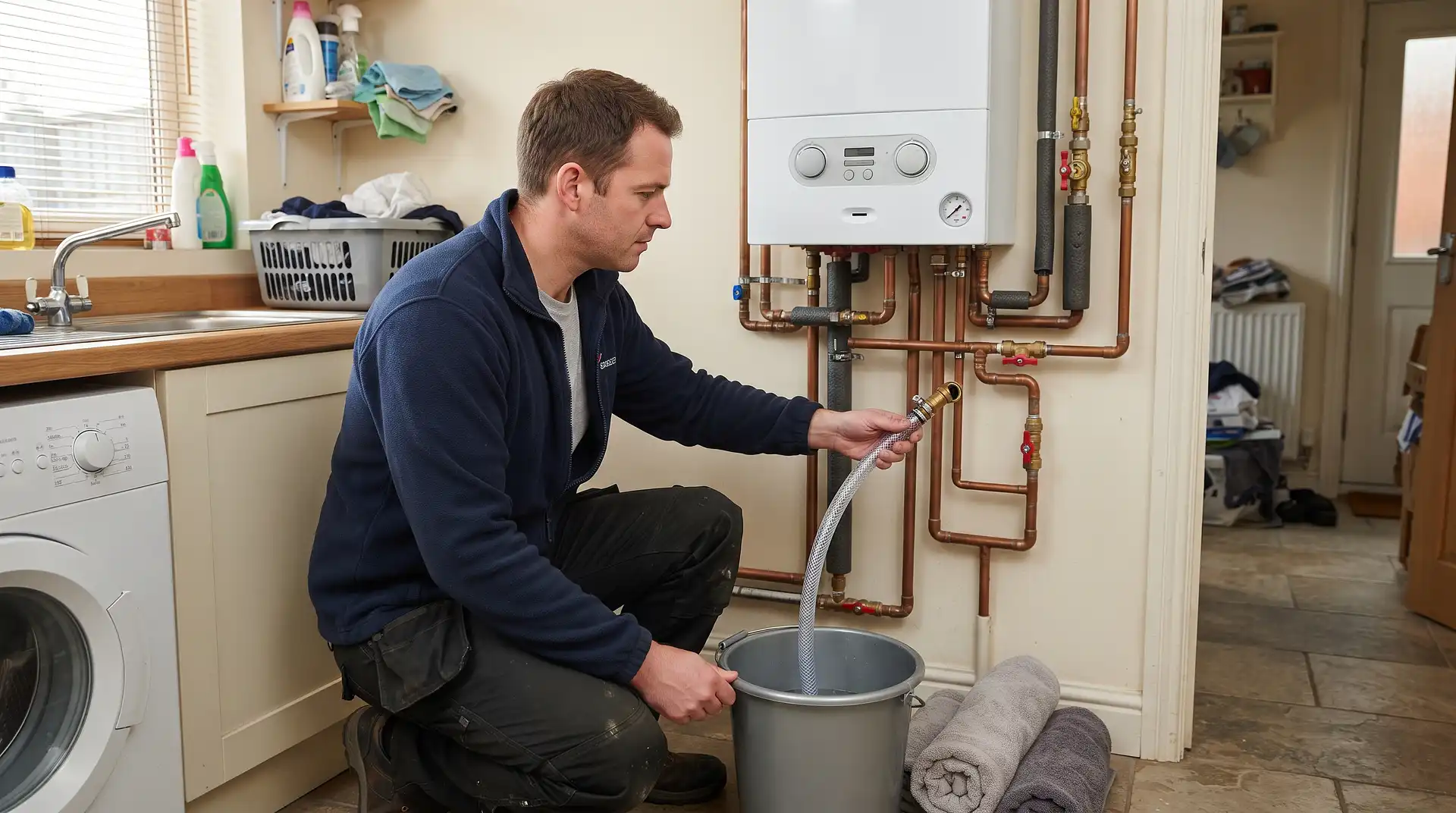
Step 4: Attach the hose
Push the hose securely over the drain outlet and use a hose clip if needed. Run the other end to an outside drain or place it in a bucket that can safely hold dirty heating water.
Central-heating water can contain black magnetite sludge and corrosion inhibitor. Keep it away from carpets, furniture, plants, ponds and surface drains where chemical discharge may be unsuitable.
Step 5: Open the valve slowly
Open the drain-off valve only slightly. You should hear or see a controlled flow of water through the hose.
Watch the boiler pressure gauge as the water leaves the system. The reading can fall quickly, so release a small amount at a time.
Step 6: Stop at the correct cold pressure
Close the drain-off valve when the gauge reaches the cold pressure stated in the boiler manual. For many domestic boilers, this is between 1 and 1.5 bar.
Do not deliberately lower the reading below 1 bar unless your manufacturer specifies a lower target. Removing too much water may cause a low-pressure fault and require the system to be refilled.
Step 7: Check the valve for leaks
Remove the hose carefully and dry the valve. Place a dry tissue around the outlet and check it after several minutes. Any dampness may mean the valve has not sealed properly.
Old or corroded drain-off valves can begin dripping after they are disturbed. Do not force a stiff valve or overtighten it. A leaking valve needs repair or replacement.
Step 8: Test the heating
Turn the boiler back on and run the heating. Watch how the pressure changes from cold to hot.
A small increase is normal. If it climbs towards 2.5 or 3 bar again, the system may have an expansion-vessel, filling-valve or pressure-relief fault.
Check Boiler Repair Costs
Compare typical UK costs for boiler servicing, fault diagnosis and heating-system repairs.
Can you lower boiler pressure from a magnetic filter?
Some magnetic heating-system filters have a drain or service valve. A heating engineer may use this point to release water, but the correct procedure depends on the filter model and installation.
Do not open a filter valve unless the manufacturer’s instructions clearly identify it as a suitable homeowner control. Opening the wrong part can release dirty water, admit air or damage a seal.
A proper external drain-off valve is normally the clearer option when you need to lower pressure without bleeding a radiator.
Should you use the pressure relief valve?
Do not manually operate the pressure relief valve as a routine way to reduce boiler pressure. The valve is a safety device designed to discharge water when system pressure becomes excessive.
Opening it manually can allow dirt or scale to become trapped on the seal. The valve may then continue dripping after it closes, causing the boiler pressure to fall repeatedly.
The pressure relief valve is usually connected to a discharge pipe that ends outside the property. Never block, cap or alter that pipe.
Why does pressure rise again after draining water?
If the pressure rises again, removing more water is unlikely to provide a lasting solution. The pattern can help identify the likely cause.
Pressure pattern | Possible cause | Next step |
|---|---|---|
Pressure increases slowly while the boiler is cold | Filling loop or filling valve passing water | Check that the loop is closed and arrange an inspection |
Pressure is normal cold but approaches 3 bar when hot | Expansion vessel may have lost its charge | Book a heating engineer |
Pressure rises and water drips from an outside copper pipe | Pressure relief valve is discharging | Turn off the heating and arrange a repair |
Pressure drops below 1 bar after cooling | Water loss, leaking valve or expansion-vessel fault | Check for visible leaks and obtain professional diagnosis |
If you accidentally remove too much water, follow the manufacturer’s instructions for topping up the system. InstantCost’s guide explains how to increase boiler pressure safely.
How much does a boiler pressure repair cost?
Draining a small amount of water through an existing serviceable valve has no direct cost. If the pressure rises again or a valve starts leaking, professional diagnosis may be required.
Work required | Typical InstantCost UK price |
|---|---|
Heating engineer call-out and diagnosis | £80 to £150 |
Pressure relief valve replacement | £100 to £200 |
Expansion vessel recharge or replacement | £150 to £300 |
Leak detection and repair | £150 to £400 |
Prices are based on InstantCost’s 2026 UK boiler and plumbing data. The final amount depends on the boiler model, fault, replacement parts, location and access.
Common mistakes to avoid
Checking the gauge while the system is hot: Wait for the boiler and radiators to cool before deciding the cold pressure is too high.
Leaving the filling loop open: Confirm that every filling control is closed before draining water.
Opening an unidentified valve: Use the boiler manual and only operate a clearly identified heating-system drain point.
Using the pressure relief valve: This safety component can fail to reseal after manual operation.
Draining too quickly: Open the valve slightly and monitor the gauge continuously.
Lowering the pressure too far: Stop within the boiler manufacturer’s recommended cold range.
Ignoring recurring high pressure: A repeated increase can indicate an expansion-vessel or filling-valve fault.
Removing the boiler casing: Internal inspection and repair should be left to a suitably qualified engineer.
Boiler pressure safety guidance
Stay safe: Work only on an external water-side control that the boiler or heating-system instructions identify as suitable for use. Never remove the boiler casing, interfere with combustion components, block a discharge pipe or work on a gas connection.
If pressure approaches 3 bar repeatedly, water discharges outside, the drain valve will not reseal or you cannot identify the correct controls, stop and use the official Gas Safe Register to find and check a registered engineer.
If you smell gas, do not attempt to adjust the boiler. Avoid electrical switches, leave the property and call the National Gas Emergency Service on 0800 111 999 from a safe place.
Frequently asked questions
Can I lower boiler pressure without touching a radiator?
Yes. If the heating system has an accessible drain-off valve, you can release a small amount of cold system water through that point. Use a hose, open the valve slowly and close it when the gauge reaches the manufacturer’s recommended range.
What pressure should I lower my boiler to?
Many domestic boilers should read around 1 to 1.5 bar when cold. Check the instructions for your model because the correct target can vary slightly.
Why is my boiler pressure high only when the heating is on?
Some increase is normal because water expands as it warms. A sharp rise from a normal cold reading to nearly 3 bar can indicate that the expansion vessel has lost its charge or failed.
Can I reduce boiler pressure by turning a valve under the boiler?
Only operate a valve that has been positively identified in the manufacturer’s instructions. The valves beneath a boiler can control water, heating flow, gas or the filling loop. Turning the wrong one can cause a leak or shut down the appliance.
Is boiler pressure at 2 bar dangerous?
A reading of 2 bar while the system is hot is often within the normal operating range. A cold reading above 2 bar suggests that the system may be overfilled. Check the boiler manual and monitor whether the pressure rises further.
Why does my boiler reach 3 bar after I lower the pressure?
Repeatedly reaching 3 bar can indicate a failed or uncharged expansion vessel, a filling valve that is passing water or another system fault. Further draining will only provide temporary relief, so arrange professional diagnosis.
Reduce the pressure carefully and monitor the result
Using a proper drain-off point lets you lower boiler pressure without bleeding radiators. Work only when the system is cold, release water slowly and stop within the recommended range.
After restarting the heating, check both the cold and hot readings. Pressure that keeps increasing needs diagnosis because a healthy sealed system should not require repeated draining.
Estimate the Cost of a Boiler Repair
Check current UK boiler and heating-system prices before arranging an engineer’s visit.