How Does an LED Light Work
1 October 2026
An LED light works by passing an electric current through a small semiconductor. Inside this material, electrons move across a junction and release energy as tiny particles of light called photons. This process produces light directly, without heating a metal filament until it glows.
Quick answer: LED means light-emitting diode. When electricity flows through the diode in the correct direction, electrons and spaces called electron holes meet inside a semiconductor. Their energy is released as photons, which we see as light. A household LED bulb also contains a driver to control the electricity, a heat sink to remove unwanted heat and a lens or diffuser to spread the light.
What does LED mean?
LED stands for light-emitting diode. Each part of the name describes what the component does:
Light-emitting: it releases visible light when electricity passes through it.
Diode: it is an electronic component designed to allow current to travel mainly in one direction.
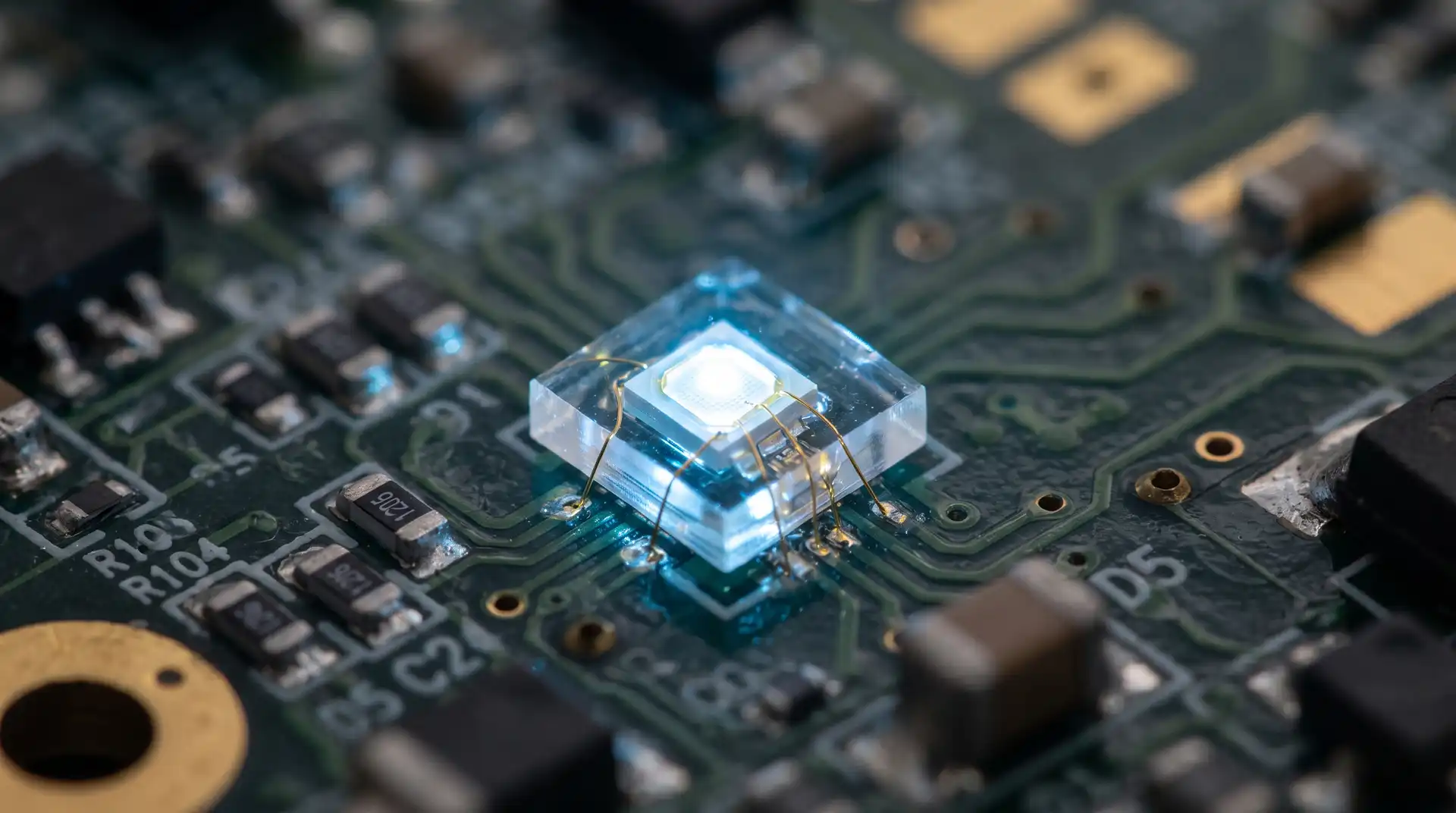
The actual light-producing part can be extremely small. A household LED bulb normally contains one or more LED chips, together with other components that make them suitable for a UK electricity supply.
How does an LED produce light?
An LED produces light through a process called electroluminescence. The complete physics can become complicated, but the basic process is easy to understand.
1. The LED contains a semiconductor
A semiconductor is a material whose electrical behaviour can be carefully controlled. It is neither a normal conductor such as copper nor a complete insulator such as plastic.
The semiconductor inside an LED is prepared to create two regions:
an n-type region with extra electrons;
a p-type region containing spaces where electrons can move, called electron holes.
The boundary where these two regions meet is called a p-n junction.
2. Electric current crosses the junction
When the correct voltage is applied in the forward direction, electrons move from the n-type region towards the p-type region. Electron holes appear to move in the opposite direction.
This movement happens at the junction inside the LED chip.
3. Electrons meet electron holes
When an electron combines with an electron hole, it moves to a lower energy state. The extra energy must go somewhere.
In a light-emitting semiconductor, much of that energy is released as a photon. A photon is a small packet of light energy.
4. The photons leave the LED as visible light
Millions of these events happen continuously while the LED operates. The large number of released photons creates the visible light produced by the lamp.
Simple comparison: An incandescent bulb uses electricity to make a wire filament extremely hot until it glows. An LED uses electricity to release photons inside a semiconductor. This is why an LED can produce a similar amount of light while using much less power.
What parts are inside an LED bulb?
The LED chip cannot normally be connected directly to a UK household lighting circuit. A complete LED bulb contains several parts that control, protect and distribute the light.
Component | What it does |
|---|---|
LED chip | Produces light when current passes through its semiconductor junction |
Driver | Converts and controls the electricity supplied to the LED chips |
Heat sink | Moves unwanted heat away from the LED junction and electronics |
Phosphor coating | Changes some of the LED’s blue light into other colours to create white light |
Lens or diffuser | Spreads the light and reduces harsh bright points |
Bulb base | Connects the lamp to an existing holder such as B22, E27 or GU10 |
What does the LED driver do?
A household lighting circuit supplies alternating current. LED chips operate using controlled direct current and are sensitive to changes in current.
The driver inside an LED lamp converts and regulates the incoming electricity so the chips receive a suitable supply. Depending on the product, it may:
convert alternating current into direct current;
limit the current passing through the chips;
smooth variations in the electrical supply;
support dimming;
protect the LEDs from excessive voltage or temperature.
The driver is one of the most important differences between a well-made LED lamp and a poor-quality product. Cheap or badly designed drivers can cause flickering, buzzing, delayed starting or early failure even when the LED chips are still usable.
How does an LED make white light?
An individual LED junction naturally produces a relatively narrow colour of light. The colour depends on the semiconductor material and the amount of energy released by the electrons.
Most white household LEDs begin with a blue LED chip. A phosphor coating absorbs part of the blue light and releases it again at different wavelengths. The remaining blue light combines with the converted colours and appears white to the human eye.
The phosphor mixture can be adjusted to create different shades of white.
Warm white
Warm-white LEDs usually have a colour temperature of around 2,700K to 3,000K. They produce a softer yellow-white appearance similar to traditional incandescent lighting.
This colour is commonly used in bedrooms, lounges and dining rooms.
Neutral white
Neutral-white products are commonly around 3,500K to 4,000K. Their light appears clearer and less yellow than warm white.
They are often used in kitchens, bathrooms, offices and work areas.
Cool white
Cool-white LEDs are commonly rated around 5,000K to 6,500K. They have a brighter blue-white appearance and are often used in garages, utility areas and task lighting.
A higher Kelvin figure describes a cooler-looking colour. It does not automatically mean the bulb is brighter.
How do colour-changing LED lights work?
Colour-changing lights normally contain separate red, green and blue LED chips. These are often called RGB LEDs.
The controller changes the brightness of each colour. Mixing different amounts of red, green and blue can produce a wide range of visible colours.
For example:
red and green can produce yellow;
red and blue can produce magenta;
green and blue can produce cyan;
all three together can produce an approximate white.
Some smart bulbs also contain dedicated warm-white and cool-white LEDs. These products can usually create better everyday white light than an RGB bulb relying only on mixed coloured chips.
Why do LEDs use less electricity?
An old incandescent bulb creates light by heating a thin filament to a very high temperature. A large part of its electrical energy becomes heat rather than useful visible light.
An LED produces light through electron movement inside a semiconductor. Less electricity is wasted heating a filament, so a lower-wattage LED can produce a similar number of lumens.
Traditional bulb | Approximate LED alternative | Typical brightness |
|---|---|---|
40W incandescent | Around 5W to 7W LED | Approximately 470 lumens |
60W incandescent | Around 8W to 10W LED | Approximately 800 lumens |
100W incandescent | Around 13W to 17W LED | Approximately 1,500 lumens |
These are broad comparisons because efficiency varies between LED products. Use lumens to compare brightness and watts to compare electricity consumption.
Check UK Lighting Installation Costs
Estimate the price of replacing fittings, installing spotlights or arranging electrical fault finding.
Do LED lights produce heat?
LEDs produce much less radiant heat than incandescent and halogen lamps, but they are not heat-free. Some electrical energy still becomes heat inside the LED junction and driver.
The heat sink moves this unwanted heat away from the sensitive electronic components. On a replacement bulb, it is usually built into the body between the light diffuser and base.
Good heat control is essential because excessive temperature can:
reduce brightness over time;
change the colour of the light;
damage the driver;
shorten the lamp’s working life.
An LED bulb installed in a fully enclosed fitting may run hotter than the same bulb in an open fitting. Check whether the bulb is approved for enclosed use.
How does an LED dim?
An LED cannot always be dimmed by simply reducing voltage in the same way as a traditional filament lamp. The LED driver must be designed to work with a suitable dimming method.
Brightness can be controlled by:
reducing the regulated current through the LED;
switching the LED on and off very rapidly using pulse-width modulation;
using a compatible mains dimmer and dimmable LED driver.
The rapid switching used by a properly designed controller happens too quickly for most people to see. The eye interprets the repeated pulses as a lower brightness.
A non-dimmable LED should not be used on a dimmer. An older dimmer designed for high-wattage halogen or incandescent bulbs may also fail to work properly with the low electrical load of an LED.
Why do LED lights flicker?
LED flickering normally comes from the power-control components rather than the semiconductor principle itself.
Common causes include:
a non-dimmable bulb connected to a dimmer;
an old dimmer that is not compatible with LEDs;
a bulb load below the dimmer’s minimum rating;
a failing LED driver;
a loose bulb or fitting connection;
a loose connection elsewhere in the lighting circuit;
voltage changes in the electrical supply.
Flickering limited to a low dimmer setting often suggests a compatibility problem. Flickering accompanied by buzzing, heat, scorch marks or a burning smell can indicate an electrical fault.
InstantCost’s guide to fixing flickering lights explains how to separate a simple bulb problem from a fault requiring an electrician.
Why do LED lights last longer?
An LED does not contain a fragile filament that repeatedly heats and cools. This removes one of the main failure points found in traditional bulbs.
LEDs also operate at a lower power for the same useful brightness. However, the final product contains more than an LED chip. Its lifespan depends on:
driver quality;
operating temperature;
heat-sink design;
airflow around the lamp;
voltage quality;
how frequently it is switched;
whether it is used with a compatible dimmer.
LEDs often become gradually dimmer instead of suddenly burning out. In other cases, the driver fails first and the light stops working even though the semiconductor chips could still produce light.
Replaceable LED bulbs and integrated fittings
A replaceable LED bulb is a separate lamp that fits into a standard holder such as B22, E27 or GU10. When it fails, the bulb can normally be removed and replaced.
An integrated LED fitting has the LED chips and driver built into the complete light. It may offer a slim design and good heat control, but there may be no separate bulb to replace.
Feature | Replaceable LED bulb | Integrated LED fitting |
|---|---|---|
Light source | Separate removable bulb | Built into the fitting |
When it fails | Replace the bulb | Driver, LED module or entire fitting may need replacement |
Changing colour or brightness | Usually easy by fitting another compatible bulb | May require replacing the fitting |
Installation | Simple bulb replacement | Fixed-wiring work may require an electrician |
Understanding LED bulb labels
An LED package usually provides several figures. Each describes a different part of its performance.
Watts
Watts measure the electrical power used. They do not directly measure brightness.
Lumens
Lumens measure the quantity of visible light. Compare lumens when choosing how bright a replacement should be.
Kelvin
Kelvin describes the appearance of the white light. Lower figures look warmer and more yellow. Higher figures look cooler and more blue.
Colour rendering index
The colour rendering index, commonly shortened to CRI, describes how naturally colours appear under the light. A higher CRI can be useful where colour accuracy matters, such as kitchens, dressing areas and workspaces.
Beam angle
Beam angle describes how widely the light spreads. A narrow beam creates a concentrated spotlight, while a wide beam covers more of a room.
Dimmable or non-dimmable
The packaging should state whether the lamp is dimmable. A dimmable LED still needs a compatible dimmer control.
How much does LED lighting cost?
A simple replacement bulb is inexpensive. Fixed-lighting work costs more when an electrician must replace integrated fittings, install new spotlights or diagnose a circuit fault.
Item or service | Typical InstantCost UK figure |
|---|---|
Replacement LED bulb | £3 to £15 |
LED-compatible dimmer, part only | £10 to £25 |
Electrical fault finding, first hour | £40 to £100 |
Electrician hourly rate | £40 to £75 per hour |
Light fitting or spotlights supplied and fitted | £120 to £280 per room |
These figures are based on InstantCost’s 2026 UK electrician pricing data. The final cost depends on the number of fittings, access, cable condition, fitting type and whether certification is required.
Common LED lighting misunderstandings
Watts measure brightness: Watts measure electricity use. Lumens measure light output.
LEDs produce no heat: They produce less radiant heat than traditional bulbs, but the chips and driver still need effective cooling.
Every LED works with a dimmer: Both the lamp and driver must be dimmable, and the dimmer must be LED compatible.
A higher Kelvin rating is brighter: Kelvin describes colour appearance, not brightness.
Every LED fitting contains a replaceable bulb: Integrated fittings may require the module, driver or complete light to be replaced.
Flickering always means the bulb is failing: It can also indicate dimmer incompatibility or an electrical connection fault.
The LED chip is the only important part: Driver and heat-sink quality can determine how reliably the complete lamp operates.
LED lighting safety
Stay safe: Switch off the light and allow it to cool before replacing a bulb. Use the correct base, voltage, brightness and enclosed-fitting rating. Stop using a light that buzzes, smells of burning, shows scorch marks or makes its switch or fitting unusually hot.
Replacing a bulb is different from altering fixed wiring. New circuits and certain work in special locations must follow the applicable electrical rules. Check the government’s Approved Document P electrical-safety guidance and use a qualified electrician for work beyond a straightforward bulb change.
Frequently asked questions
How does an LED turn electricity into light?
Electricity moves electrons through a semiconductor junction. When electrons combine with electron holes, they release energy as photons. These photons create the visible light.
Why does an LED need a driver?
The driver converts and controls the electricity supplied to the LED chips. Without proper current regulation, the chips could flicker, overheat or fail.
Why are most white LEDs actually blue underneath?
Many white LEDs use a blue light-producing chip covered by phosphor. The phosphor changes part of the blue light into other colours. The combined wavelengths appear white.
Why do LED bulbs stay cooler than old bulbs?
LEDs do not need to heat a filament until it glows. They still produce some heat, but much less is emitted as radiant heat. A heat sink carries unwanted heat away from the electronic components.
Can any LED bulb be used with a dimmer?
No. The bulb must be marked as dimmable, and the wall dimmer must be compatible with LED loads. An unsuitable combination can cause flickering, buzzing or a limited dimming range.
Why has my integrated LED light stopped working?
The LED chips, driver or another electronic component may have failed. Some fittings have replaceable drivers or modules, while others require complete replacement by an electrician.
The simple science behind LED lighting
An LED creates light when electrons release energy as photons inside a semiconductor. The driver controls the electricity, the phosphor helps create white light, the heat sink controls temperature and the diffuser spreads the light around the room.
This direct method of creating light explains why LEDs can provide useful brightness with far less electricity than a heated filament. Choosing the right lumens, colour temperature, fitting type and dimmer compatibility helps the complete product work properly.
Planning New LED Lighting?
Check current UK prices for light fittings, spotlights, dimmer replacement and electrical work.