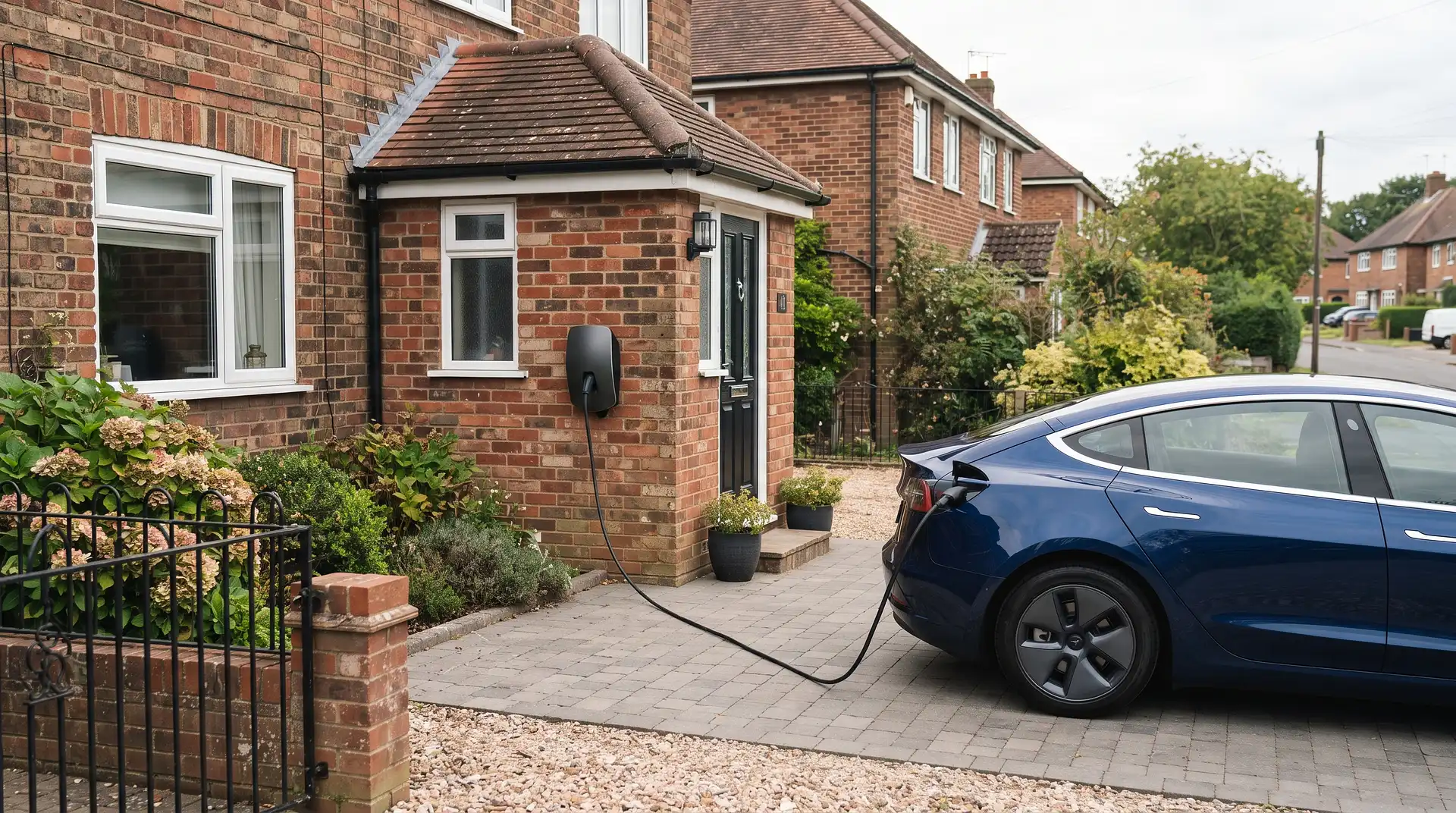
How Much Space Is Needed for an EV Charger
2 October 2026
A home EV charger does not take up much physical space. Most wall-mounted units are approximately 20cm to 40cm wide and 10cm to 20cm deep. However, you need more than enough room for the box itself. The installer also needs a solid mounting surface, safe working space, a suitable cable route and easy access to your car's charging port.
Quick answer: For a normal home installation, allow a clear wall area of at least 50cm wide and 60cm high, plus any additional clearance required by the charger manufacturer. The parked car must be close enough for the charging cable to reach without being stretched, driven over or placed across a pedestrian route. A typical 5 to 7.5 metre cable is enough for many driveways.
How Much Wall Space Does an EV Charger Need?
The charger itself is normally smaller than people expect. Many domestic wallboxes are similar in size to a small backpack or large tablet. Compact models can be about 20cm wide, while larger chargers with built-in cable storage or a display may be closer to 40cm wide.
As a practical starting point, look for a wall area with:
At least 50cm of clear width.
At least 60cm of clear height.
Enough depth for a unit projecting approximately 10cm to 20cm.
Additional room for the cable, plug and any separate cable holder.
Clear access for installation, testing and future maintenance.
These are useful planning measurements rather than universal legal minimums for every existing home. Each manufacturer provides its own clearance requirements, and these take priority when the installer positions the charger.
A tethered charger usually needs more usable wall space than an untethered model because its fixed cable must be coiled or placed on a holder when it is not in use.
England's Part S Space Guidance
For new buildings and certain buildings undergoing major renovation or a material change of use in England, Approved Document S gives dimensions for future EV chargepoint locations.
Its wall-mounted example allows space for:
A chargepoint up to 400mm wide.
At least 800mm of free space on each side.
A chargepoint up to 500mm high.
A unit projecting up to 200mm from the wall.
The bottom of the unit to be between 700mm and 1,000mm above the floor.
This creates a total clear wall span of approximately 2 metres in the illustrated future installation area. The dimensions help ensure that a charger can be installed, accessed and maintained properly.
The guidance does not mean that every existing homeowner must find a completely empty 2-metre wall before replacing or installing a charger. It applies to the types of building work covered by Part S in England. A qualified installer must assess an existing property using current electrical requirements, manufacturer instructions and the conditions at the site. You can review the official Approved Document S guidance for its exact scope.
Do You Need a Driveway?
The simplest home installation has a private driveway, garage, carport or allocated parking space within the property boundary. The car does not need a larger parking space just because it is electric, but you must be able to connect it without creating an obstruction.
Check that:
The car fits fully within the parking area.
You can open the required doors while the charging cable is connected.
The plug can reach the car's charging port in its normal parking position.
The cable does not cross steps, doorways or busy walking routes.
The cable cannot become trapped under a garage door.
No part of the vehicle can strike the charger while parking.
A narrow driveway can still be suitable. The charger can sometimes be positioned near the front or rear corner of the parking space instead of directly beside the driver's door. The best position depends on where the charging port is located on the vehicle.
How Close Must the Charger Be to the Car?
The charging cable must reach the vehicle without being pulled tight. Many domestic chargers have a cable approximately 5 metres long, while some offer 7.5 or 10 metre options.
Do not measure in a straight line through the car. Measure the route the cable will actually follow from the charger to the charging port, including:
The height of the charger above the ground.
The distance along or around the parked vehicle.
The position of the charging port.
Any gate, wall, step or planter that the cable must avoid.
Whether the car will be parked forwards or reversed onto the drive.
Leave some slack so the connector can be inserted and removed without pulling against the car or charger. Excessive slack should not be left across the ground because it can become a trip hazard.
Where Is the Best Place to Install the Charger?
The best position is usually on an exterior wall close to the parking space and reasonably close to the consumer unit. A shorter supply cable route normally makes the installation easier and less expensive.
A good location should have:
A solid wall or approved mounting post.
Easy access to the car's charging port.
A safe and practical route for the electrical cable.
Enough space to coil or store the charging lead.
Reliable mobile data or Wi-Fi if the charger needs it.
Protection from accidental vehicle impact.
Suitable drainage without regular standing water.
Space for the installer to open and maintain the unit.
Outdoor chargers are designed for external use when installed correctly. A roof or enclosed garage is not usually required, but the charger must have the correct environmental rating and be installed according to its instructions.
Check the Charging Port Position Before Installation
Charging ports appear in different places on different cars. They may be:
At the front of the vehicle.
On the front wing.
Behind a panel near the rear wheel.
At the rear of the vehicle.
A position that works perfectly for one EV might leave the cable too short for another. If you expect to change cars, choose a central charger position or a cable long enough to reach more than one possible port location.
For a two-car driveway, consider whether the charger needs to serve both spaces. A charger placed between the spaces may work, provided the cable does not pass behind one parked vehicle or create a walking hazard.
How Much Space Does a Charger Post Need?
If there is no suitable wall beside the parking space, a charger can be installed on a mounting post or pedestal. The post needs a stable base and an underground or protected cable route.
Allow enough space for:
The post and charger.
A concrete foundation or mounting base.
Cable entry below or behind the post.
Opening and maintaining the charger.
Protective bollards where a vehicle could strike it.
Safe movement around the parked car.
If a vehicle barrier is required, around 500mm of additional space may be needed around the charger location. The installer should make sure the bollard protects the equipment without blocking access to the socket, controls or cable.
Calculate Your EV Charger Installation Cost
Enter your parking arrangement, cable distance, charger speed and consumer unit requirements for a current UK estimate.
How Far Can the Charger Be From the Consumer Unit?
There is no single maximum distance for every home. A charger can be installed on a detached garage, boundary wall or post away from the house if the electrical circuit is designed correctly.
However, distance affects:
The amount and size of cable required.
The method used to protect the cable.
Voltage drop calculations.
The amount of drilling, clipping or trenching.
Installation time and labour cost.
A short route through one exterior wall is normally straightforward. A charger on a detached garage or the far end of a driveway may require an armoured cable, underground duct or trench.
Do not confuse the supply cable with the charging lead. The supply cable carries electricity from the consumer unit to the wallbox. The charging lead connects the wallbox to the car.
How Much Does Installation Cost?
The amount of space available does not usually change the price by itself. The cost rises when a restricted location requires a longer cable, groundworks, a mounting post or changes to the consumer unit.
EV charger installation | Typical 2026 UK price | Space-related consideration |
|---|---|---|
7kW standard installation | £900 to £1,400 | Usually includes a cable run under 10 metres |
7kW charger with long cable run | £1,200 to £1,800 | May involve more than 15 metres of cable or trenching |
22kW charger | £1,400 to £2,200 | Requires a suitable three-phase supply |
Consumer unit upgrade | £450 to £900 | Enough space must be available for the replacement board |
Installation without off-street parking | £1,500 to £2,500 | May require a permitted cable channel and council approval |
These figures come from InstantCost's 2026 UK EV charger installation data. The final quote should be based on a site survey, cable length and the condition of the existing electrical installation.
Can You Install a Charger Without Off-Street Parking?
Lack of a driveway does not always make home charging impossible, but it changes the space and permission requirements.
You cannot place an ordinary charging cable loosely across a public pavement. It can obstruct pedestrians, wheelchair users and people with pushchairs. It may also expose the cable to damage.
Some councils permit approved cross-pavement channels or covered cable gullies. Availability, design standards and application processes vary between local authorities. The charger must normally remain on your property, and you may need permission before altering the pavement.
Where an on-street solution is proposed, electrical equipment connected to different earthing systems may need to be separated by at least 2.5 metres. A qualified installer must check nearby streetlights, neighbouring chargers and accessible metalwork.
Space Inside the Consumer Unit
The wall beside the car is only one part of the survey. The electrician also needs to check whether the consumer unit has space and capacity for the new circuit.
If there is no suitable spare way, the installer may propose:
A separate small consumer unit for the charger.
An approved connection arrangement near the meter.
Replacement of an old or unsuitable consumer unit.
Additional electrical protection required by the charger design.
A charger should not be installed by simply squeezing another circuit into an unsuitable board. The electrician must calculate maximum demand and check the main supply before the work proceeds.
Safety Guide
EV charger installation is fixed electrical work and must be completed by a qualified electrician. Do not install the unit, open the electricity meter or interfere with the main service fuse yourself.
The charger should not be placed where it could be hit by a car, damaged by a closing gate or submerged in standing water. Charging cables should not be stretched, crushed under tyres or wrapped tightly around the unit while charging.
The installer must also assess the earthing arrangement, circuit protection, load demand and DNO notification requirements. Ask for an Electrical Installation Certificate and any required Building Regulations compliance documentation when the work is complete.
Common Space Planning Mistakes
Measuring Only the Charger
The wallbox might fit, but its cover, socket or attached cable may be difficult to use. Allow room for operation and servicing as well as the charger's stated dimensions.
Ignoring the Car's Charging Port
A cable that reaches the parking space may still be too short to reach the actual port. Park the car normally and measure the full route before choosing the charger position.
Planning to Use an Extension Lead
A home wallbox should be located so its approved charging cable reaches the vehicle. Do not plan the installation around a domestic extension lead.
Mounting It Where a Car Can Hit It
A charger installed directly in front of a parking bay can be vulnerable. Move it to one side or use suitable impact protection where necessary.
Blocking a Door or Walking Route
The charger and cable should not reduce safe access to the home. Check gates, garage doors, steps, bins and regular pedestrian routes during the survey.
Choosing the Shortest Electrical Route Only
The closest wall to the consumer unit is not always the best daily location. Cable reach, car position and safe access are equally important.
EV Charger Space Checklist
Before requesting a quotation, check the following:
Is there a solid wall or space for a mounting post?
Is there at least 50cm by 60cm of clear wall space?
Can the unit be opened and maintained?
Will the cable reach the car without being stretched?
Can the cable reach different charging port positions?
Will the cable avoid doors, gates, steps and walking routes?
Can the charger be protected from vehicle impact?
Is there a practical route back to the consumer unit?
Is a suitable mobile or Wi-Fi signal available?
Do you own the wall and parking space, or have permission to use them?
For more help preparing the property and choosing the right equipment, read our guide on how to charge an electric car at home.
Frequently Asked Questions
What is the minimum wall space for an EV charger?
A clear area of approximately 50cm wide and 60cm high is a useful starting point for many domestic chargers. The exact requirement depends on the unit's dimensions, cable storage and manufacturer instructions.
Can an EV charger be fitted in a narrow driveway?
Yes, provided the charger and cable do not block access or risk being hit by the vehicle. A corner position, longer charging cable or post-mounted unit may solve a restricted layout.
How close should an EV charger be to the car?
It should be close enough for the approved charging cable to reach the vehicle's port with some slack. Many home charger cables are approximately 5 to 7.5 metres long.
Does the charger have to be beside the consumer unit?
No. It can be installed farther away if the electrician designs a suitable circuit. Longer routes may require more cable, protective ducting, trenching or a larger cable size.
Can I put an EV charger inside a garage?
Yes. The charger can be installed in a garage if there is a suitable mounting surface, safe electrical supply and enough room to connect the car. Check that the cable will not be trapped by the garage door.
Can one charger serve two parking spaces?
It may be possible if the charger is positioned centrally and its cable safely reaches both cars. The cable must not pass through a route where it could be driven over or create a trip hazard.
Price Your Home EV Charger
Use your postcode and installation details to see a tailored UK cost range in seconds.