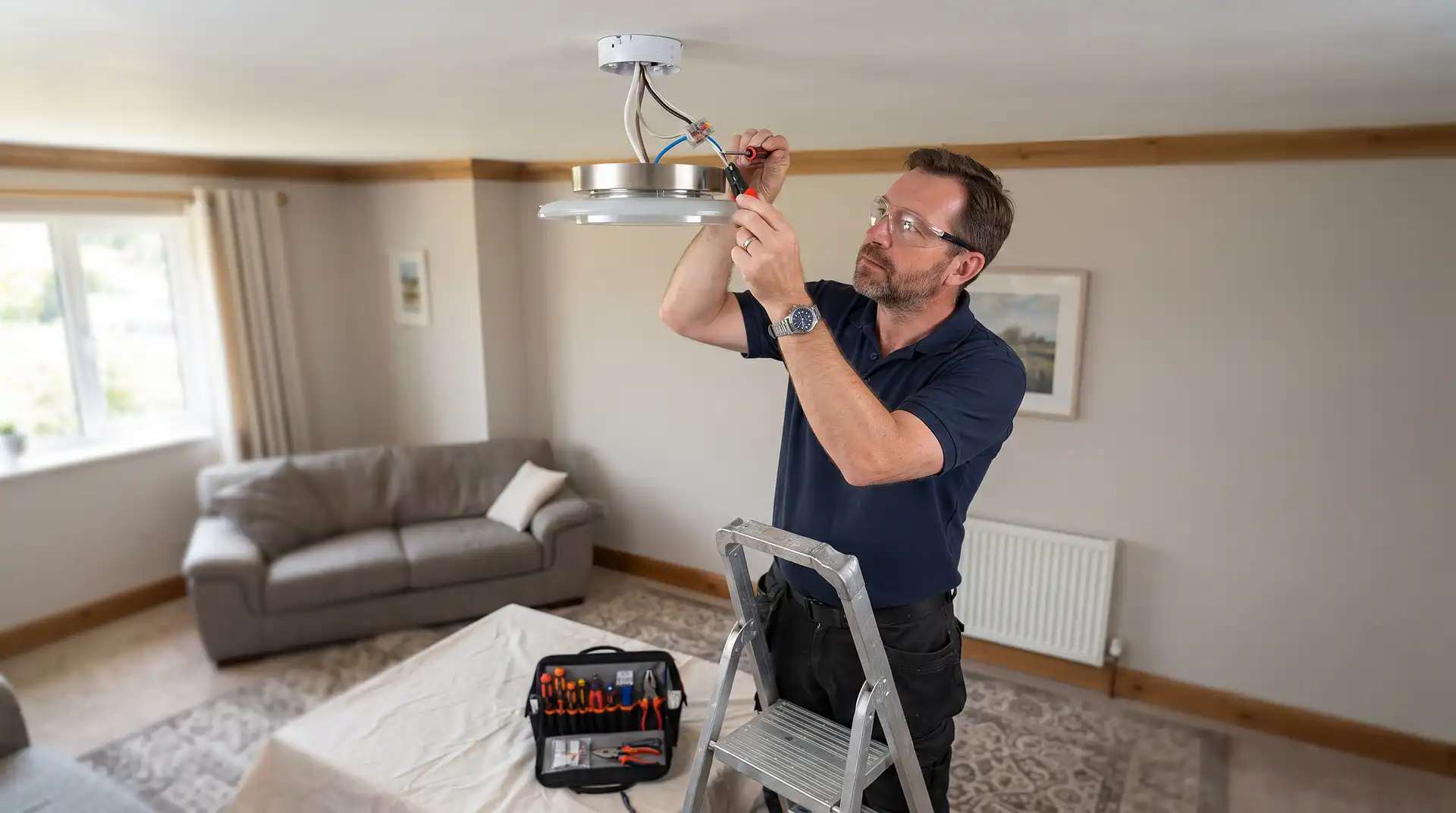
How to Change a Light Fitting UK
5 October 2026
How to Change a Light Fitting in the UK
To change a light fitting, isolate the correct lighting circuit at the consumer unit, prove that every conductor is dead, remove the old fitting and connect the new fitting according to its manufacturer’s instructions. A simple like-for-like replacement may be suitable for a competent person who understands electrical isolation and testing. New wiring, altered circuits, bathroom fittings and uncertain or damaged wiring should be handled by a qualified electrician.
Quick answer: Turn off the lighting circuit at the consumer unit, lock or label it off and prove the wires are dead with a suitable two-pole voltage tester. Photograph and label the existing connections, then install the new fitting exactly as its instructions show. Stop if the wiring does not match, the ceiling is damaged, the fitting is heavy or the work is in a bathroom or another special location.
Changing a bulb is a low-risk maintenance task. Changing a fixed light fitting involves the electrical installation and must be approached more carefully. Turning off the wall switch alone does not guarantee that the wires at the ceiling are safe.
Is It Safe to Change a Light Fitting Yourself?
A straightforward replacement of an existing fitting may be possible when:
The new fitting is suitable for the existing circuit
The existing wiring is sound and clearly identified
The circuit can be isolated safely at the consumer unit
You have a proper two-pole voltage tester and know how to use it
The fitting is lightweight and the ceiling can support it
The work is not in a bathroom or another special location
No new cable, switch position or circuit alteration is required
Use an electrician instead when:
The wires are damaged, brittle, scorched or unusually arranged
The circuit contains old wiring that you cannot identify
You are adding a new light point or moving the existing point
The light is in a bathroom, shower room or outside area
The fitting is heavy or needs additional ceiling support
The circuit breaker trips or the fitting buzzes after installation
You cannot prove that every conductor is dead
The related InstantCost guide on installing a light switch safely explains why switch position, conductor function and safe isolation matter even when the visible work appears simple.
What You Need
A compatible replacement light fitting
The manufacturer’s installation instructions
Insulated screwdrivers suitable for the terminals
A two-pole voltage tester
A proving unit or known live source for checking the tester
Insulation tape or labels for identifying conductors
A torch
A stable step platform, if required
A consumer-unit lockout device or warning label
A second person to support the fitting where necessary
A non-contact voltage pen can be useful as an initial warning tool, but it should not be the only method used to prove a circuit is dead. It can miss dangerous conditions or give an unreliable indication around multiple cables.
Check the New Light Fitting Before Starting
Read the instructions before isolating the circuit. Check the fitting’s voltage, maximum lamp rating, mounting method and whether it requires an earth connection.
Also check:
Whether the fitting is suitable for the room
Whether it is rated for bathroom zones or outdoor use
Whether it is dimmable or compatible with your existing dimmer
Whether it needs a neutral connection
Whether it includes a driver or transformer
Whether the ceiling can support its weight
Whether the mounting bracket fits the existing box or fixing points
Many LED fittings are integrated units. They do not have a separate replaceable bulb and may require a driver connection or dedicated mounting bracket. Do not assume that an integrated fitting uses the same connections as a pendant or ceiling rose.
How to Change a Light Fitting Step by Step
1. Turn Off the Correct Circuit
Switch off the lighting circuit at the consumer unit. Do not rely on a label without checking because older consumer units may be labelled incorrectly.
Lock the circuit breaker in the off position where possible and attach a warning label. Tell other people in the property that the circuit must not be switched back on.
2. Prove the Tester Works
Test the two-pole voltage tester on a proving unit or a known live source. This confirms that it is working before you rely on it to check the lighting circuit.
Do not skip this step. A tester that has failed can make an apparently safe circuit look dead.
3. Remove the Existing Shade and Lamp
Allow the lamp to cool fully. Remove the shade, bulb and any decorative cover carefully. Support the fitting so its weight is not hanging from the cables.
If the fitting is heavy, ask another person to hold it while you release the mounting screws. Never allow a heavy fitting to pull on the conductors.
4. Prove Every Conductor Is Dead
Use the two-pole tester to check between each relevant conductor and earth, and between conductors where appropriate. Test every conductor at the fitting, even when the wall switch is off.
After completing the dead test, prove the tester again on the proving unit or known live source. This confirms that the tester did not fail during the test.
If any voltage is detected, stop immediately. Return to the consumer unit and identify the correct circuit. Do not continue by guessing.
5. Photograph and Label the Existing Connections
Take clear photographs before disconnecting anything. Label conductors according to their terminal function, not just their colour.
UK wiring colours have changed over time. A blue or black conductor at a ceiling point may be used as a switched live rather than a neutral. Never connect a wire based only on its insulation colour.
6. Check the Earth Conductor
Confirm that the circuit protective conductor is present and correctly sleeved green and yellow. A metal fitting needs a reliable protective-earth connection unless the manufacturer specifically classifies it as double insulated.
Do not install a metal fitting when the earth connection is missing, damaged or uncertain. Ask an electrician to inspect the circuit.
7. Remove the Old Fitting
Loosen the mounting screws while supporting the fitting. Keep the conductors from falling into the ceiling or becoming trapped against sharp edges.
Inspect the ceiling, junction box and cable sheath. Stop if you find heat damage, loose plaster, exposed copper, brittle insulation or signs of previous overheating.
8. Install the New Mounting Bracket
Use the bracket, screws and fixings supplied with the new fitting where possible. Fix into a suitable joist, ceiling box or approved support rather than relying only on weak plasterboard.
Check for concealed cables and pipes before drilling. The fixing must support the fitting without crushing the cable or interfering with the terminals.
9. Connect the Fitting as Instructed
Match the circuit conductors to the terminal functions shown in the fitting instructions. A typical fitting may have terminals for live, neutral and earth, but the exact arrangement varies.
Some ceiling points contain several circuit cables and a separate switched-live conductor. This is why copying a generic online diagram can be dangerous. Use the identified functions and the manufacturer’s diagram.
Insert each conductor fully into its terminal. No bare copper should remain visible outside the terminal, and no insulation should be trapped where the terminal needs to grip the conductor.
10. Check the Connections
Gently pull each conductor to confirm that it is secure. Check that the earth conductor is connected correctly, terminals are tightened and no cable is being pinched by the fitting.
Arrange the cables with gentle bends. Do not force a large driver, transformer or connector into a shallow ceiling box where it could be crushed or overheated.
11. Secure the Fitting
Fit the light to its bracket and tighten the screws evenly. Do not overtighten plastic parts or force a fitting that does not sit squarely.
Make sure the shade, diffuser and lamp are correctly seated before restoring power.
12. Restore Power and Test
Clear tools and people from the work area before restoring the circuit. Switch the lighting circuit back on and test the fitting using the wall control.
Switch the circuit off again and arrange an electrician if:
The circuit breaker trips
The light does not operate normally
The fitting buzzes, crackles or becomes hot
The lamp flickers repeatedly
You smell burning or see scorch marks
How to Change a Ceiling Rose to a Modern Light Fitting
Older UK ceiling roses can contain several conductors because they may be part of the circuit’s loop-in arrangement. A modern light fitting may have a smaller terminal block that cannot safely accommodate all those conductors.
Do not force several wires into a terminal designed for one conductor. The circuit may require a suitable maintenance-free junction box or another approved connection method located correctly within the ceiling space.
The function of each conductor must be identified before any alteration. If the ceiling rose contains multiple cables and you are not completely certain which is permanent live, switched live, neutral and earth, stop and use an electrician.
How to Change a Light Fitting With a Dimmer
Check whether the new lamp or fitting is dimmable. A non-dimmable LED connected to a dimmer can flicker, buzz, fail to start or suffer early damage.
The dimmer must also be compatible with the lamp type and electrical load. Older dimmers designed for high-wattage halogen or incandescent lamps may not operate correctly with the lower load of LED lighting.
If the existing dimmer is causing problems, replace it with an LED-compatible model or ask an electrician to assess the circuit.
Changing a Light Fitting in a Bathroom
Bathroom lighting requires additional consideration because water and electricity are close together. The fitting must be suitable for its position and have the appropriate ingress-protection rating for the bathroom zone.
Do not install an ordinary ceiling fitting in a shower area simply because it physically fits. Bathroom alterations may also involve notification and certification requirements.
Use a registered electrician for new bathroom lighting, altered wiring or any work where the zone and protection rating are uncertain.
Changing an Outdoor Light Fitting
Outdoor fittings, cables, switches and junctions must be suitable for weather exposure and the specific installation position. Check the manufacturer’s IP rating and ensure water cannot enter the cable entry or mounting point.
Do not use indoor accessories outside or rely on sealant to make an unsuitable fitting weatherproof. Outdoor circuits may require additional RCD protection and a qualified installation.
Check the Cost of Changing a Light Fitting
Compare current UK electrician prices for fitting replacement, fault finding and new lighting work.
When You Should Call an Electrician
Use a qualified electrician if the job involves a new cable, a new switch position, a bathroom, an outdoor circuit or an unfamiliar ceiling arrangement.
You should also stop and call an electrician if:
The wiring has mixed colours that you cannot confidently identify
The earth conductor is missing or damaged
The ceiling box is loose or cannot support the fitting
The cable insulation is brittle, cracked or scorched
The old fitting has signs of overheating
The circuit breaker trips after the change
The light fitting becomes warm, buzzes or smells of burning
You do not have a proper two-pole voltage tester
You cannot prove the circuit is dead
A like-for-like replacement is different from designing or altering a lighting circuit. New cable routes and circuit changes need proper inspection, testing and certification.
How Much Does It Cost to Change a Light Fitting in the UK?
InstantCost’s current 2026 UK electrician pricing gives the following guide:
Electrical service | Typical UK cost |
|---|---|
Electrician hourly rate | £40 to £75 per hour |
Short-job call-out | £40 to £80 |
Straightforward switch repair | Approximately £85 |
Light fitting or spotlights supplied and fitted | £120 to £280 per room |
Electrical fault finding | £40 to £100 for the first hour |
The final price depends on the number of fittings, access, ceiling condition, cable condition, fitting type and whether testing or certification is required. Ask whether the quote includes the fitting, lamps, disposal and making good.
UK Electrical Safety and Certification
All electrical work in a dwelling must be completed safely. In England, Approved Document P provides statutory guidance on electrical safety in dwellings and explains when work may need notification.
Rules and certification arrangements differ between England, Wales, Scotland and Northern Ireland. A registered electrician can assess the work, test the circuit and provide the appropriate paperwork.
Never work on a live circuit. The correct process is to isolate the circuit at the consumer unit, secure it against reconnection, prove the tester works, test the conductors, then prove the tester again.
Do not rely on the wall switch being off. A ceiling point may contain permanent live conductors even when the lamp is not illuminated.
Common Light-Fitting Replacement Mistakes
Only Turning Off the Wall Switch
The wiring can remain live behind the fitting. Isolate the correct circuit at the consumer unit and prove it dead.
Matching Wires by Colour
Older wiring and switched-live arrangements do not always follow the assumptions made by generic diagrams. Identify the terminal function through testing and documentation.
Using a Non-Contact Voltage Pen Alone
A pen can miss dangerous conditions or provide false readings. Use a suitable two-pole tester that is proved before and after the dead test.
Forcing the New Fitting Into the Ceiling Box
Crushing cables or a driver can damage insulation and cause overheating. Use a suitable box, bracket or approved junction arrangement.
Ignoring the Earth Connection
Metal fittings need effective protective earthing unless they are clearly double insulated. Do not guess when the earth connection is uncertain.
Using a Non-Dimmable LED on an Old Dimmer
This can cause flickering, buzzing and premature failure. Check the lamp and dimmer compatibility together.
Installing a Standard Fitting in a Bathroom
Bathroom locations have zone and protection requirements. Use a suitable fitting and qualified electrician where the position or wiring is not straightforward.
Leaving the Circuit Unchecked After Installation
Restore power only after the fitting is secured and all covers are fitted. Check for tripping, warmth, buzzing or flickering during the first use.
Frequently Asked Questions
Can I change a ceiling light fitting myself in the UK?
A competent person may be able to replace an existing fitting like for like when the wiring is sound and the circuit can be safely isolated and tested. New wiring, bathrooms, outdoor locations and uncertain conductors should be handled by an electrician.
Do I need to turn off the consumer unit to change a light fitting?
Yes. Turn off the correct lighting circuit at the consumer unit and prove all conductors dead with a suitable two-pole tester. Turning off the wall switch is not enough.
What do I do if the new light fitting has different terminals?
Stop and follow the new fitting’s instructions. Do not connect wires by matching their physical positions or insulation colours. If the conductor functions are unclear, use an electrician.
Can I change a pendant light to an LED ceiling fitting?
Often, but the fitting may require different mounting, earthing, driver space or cable connections. Check the manufacturer’s instructions and the ceiling support before ordering.
Do I need an electrician to change a bathroom light?
Bathroom lighting has additional zone, IP-rating and certification considerations. A registered electrician is the safest choice for new or altered wiring, especially near a shower or bath.
Why does my new light fitting keep tripping the breaker?
An incorrect connection, damaged cable, trapped conductor, faulty fitting or earth fault may be present. Leave the circuit switched off and arrange an electrician instead of repeatedly resetting the breaker.
Get a UK Light-Fitting Estimate
Enter your location and electrical requirements to compare a current local cost range.