How to Handle a Denied Plumber’s Insurance Claim
4 October 2026
How to Handle a Denied Plumber’s Insurance Claim
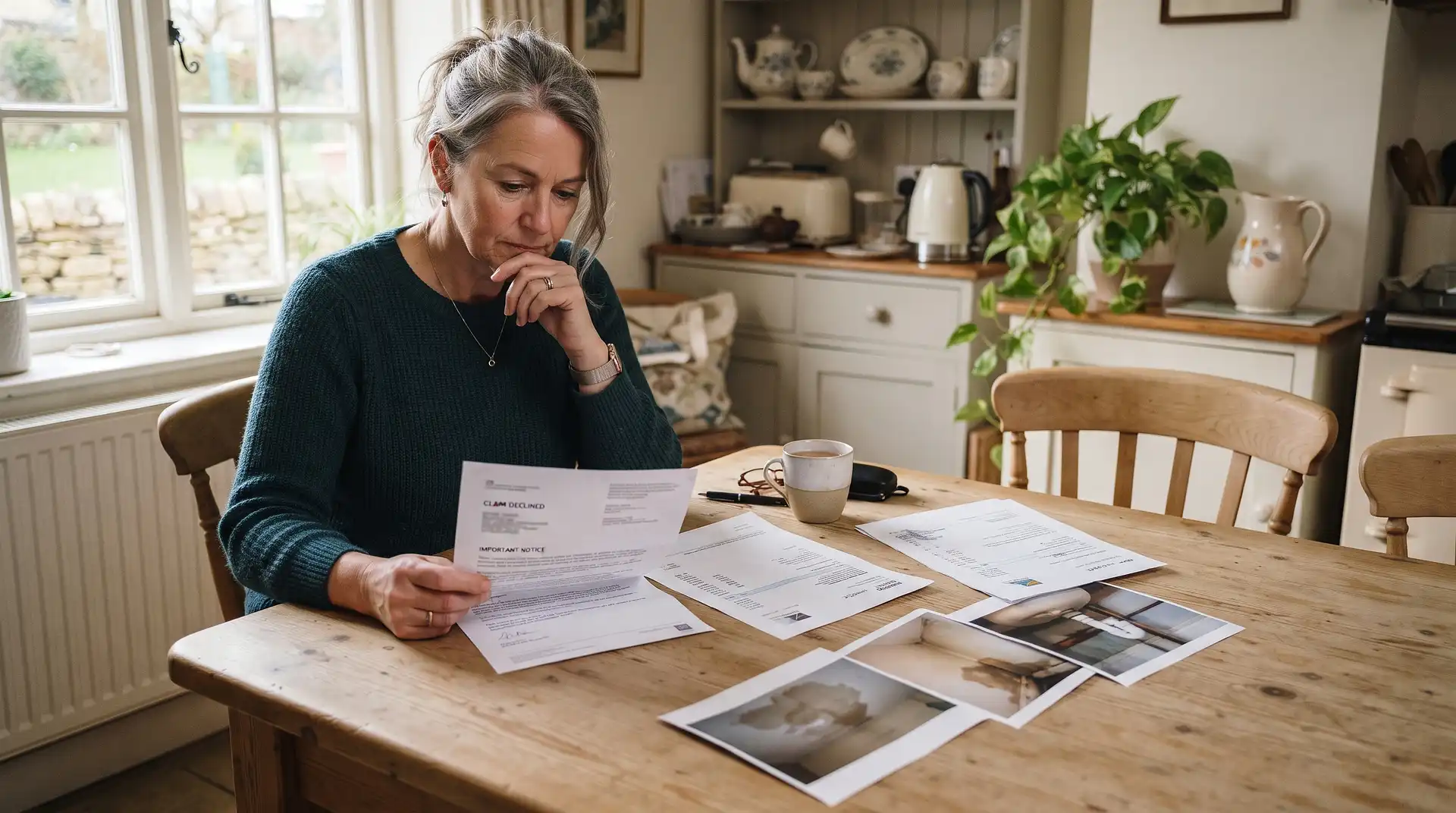
If a plumbing insurance claim is denied, ask for the decision and the exact policy clause in writing. Protect the property from further damage, keep photographs, invoices and damaged parts, and obtain an independent report explaining what caused the leak. If your own insurer rejected the claim, make a formal complaint and escalate it to the Financial Ombudsman Service when eligible. If the plumber’s liability insurer refused the claim, continue pursuing the plumber or plumbing business because the insurer’s decision does not automatically remove the plumber’s legal responsibility.
Quick answer: Obtain the denial letter, find the policy exclusion being relied upon and compare it with the facts of the incident. Preserve evidence of the leak, the plumber’s work and the resulting damage. Send a written challenge supported by an independent plumbing report and repair estimates. If the dispute concerns your own regulated insurer, complete its complaints procedure before referring the case to the Financial Ombudsman Service.
The correct response depends on whose insurance claim has been denied. A homeowner disputing a buildings-insurance decision follows a different route from someone trying to recover money from a plumber’s public liability policy.
Start by identifying which of the following situations applies:
Your home insurer rejected an escape-of-water claim
Your home-emergency insurer refused to pay for the plumbing visit
A plumber caused damage and their public liability insurer denied responsibility
You are a plumber whose own business insurer refused a claim
Stop Further Damage Before Disputing the Claim
Insurance disputes can take time. You should still take reasonable action to stop the damage from becoming worse.
Depending on the incident, this may include:
Turning off the internal stopcock
Isolating the affected appliance
Switching off electricity where water is near sockets or wiring
Arranging an emergency repair
Moving undamaged possessions away from the wet area
Removing standing water where it is safe to do so
Using suitable drying equipment after the leak is stopped
Photograph and record the damage before emergency work begins where possible. Do not delay urgent safety work simply to preserve evidence. Ask the attending plumber to record what they found before disturbing the failed fitting.
Keep receipts for emergency attendance, drying, temporary accommodation and other necessary expenses. Whether they are recoverable will depend on the policy, liability and evidence, but a claim cannot be assessed properly without records.
Ask for the Rejection in Writing
Do not rely on a telephone explanation. Ask the insurer to provide:
The full reason for rejecting the claim
The policy term, condition or exclusion being applied
Any engineer, loss-adjuster or surveyor report used
The evidence supporting its conclusion
An explanation of the complaint and appeal process
Confirmation of any part of the claim that remains covered
A denial should explain more than simply stating that the problem was wear and tear or poor workmanship. You need to know what evidence led to that conclusion and how the policy wording applies to the event.
Check What Type of Loss Was Rejected
A plumbing incident can create several different costs. They may not all be covered in the same way.
Part of the incident | Example | Why the distinction matters |
|---|---|---|
Source of the leak | Failed valve, pipe or shower seal | A policy may exclude the failed component itself |
Resulting water damage | Damaged ceiling, flooring or cabinets | Consequential damage may be assessed separately |
Trace and access | Opening a wall or floor to find the leak | Some policies provide a separate limit for this work |
Poor workmanship | An incorrectly fitted joint starts leaking | Redoing the plumber’s work may be treated differently from repairing other damage |
Emergency attendance | An out-of-hours plumber stops an active leak | This may fall under home-emergency cover rather than buildings insurance |
An insurer might refuse to pay for replacing an old pipe while still covering water damage caused by its sudden failure. Ask the insurer to explain each part of the decision instead of treating the incident as one undivided cost.
Common Reasons Plumbing Insurance Claims Are Denied
Gradual Damage or Wear and Tear
Home insurance usually deals with insured events rather than routine maintenance. An insurer may argue that a slow leak, corrosion, failed sealant or deteriorated grout developed over time.
Challenge this conclusion when the evidence shows a sudden escape of water or when the insurer has assumed gradual damage without properly investigating it. Ask what physical evidence shows how long the leak existed.
Poor Workmanship Exclusion
A policy may exclude the cost of correcting defective plumbing work. However, damage caused to other parts of the property may need separate consideration.
For example, the cost of refitting an incorrectly installed joint may be excluded while damage to the ceiling below could potentially fall within another section of the policy. The exact result depends on the wording and circumstances.
Lack of Maintenance
The insurer may say the homeowner failed to maintain the property. Request an explanation of what maintenance was expected, what evidence shows it was not completed and how that failure caused the claimed damage.
Provide previous service records, invoices, inspection reports and photographs when they support your position.
Late Notification
Policies normally require claims to be reported promptly. Explain when you first discovered the damage, what action you took and why any delay occurred.
A concealed leak may have existed before it became visible. The relevant date may be when you became aware of it rather than when an expert later estimated that it began.
Unauthorised Repairs
An insurer may object when permanent repairs were completed before it had an opportunity to inspect the damage. In an emergency, stopping an active leak may have been necessary to protect the property.
Provide photographs, the failed component, the plumber’s report and an explanation of why immediate action was required.
The Incident Falls Under a Different Policy
Buildings insurance, contents insurance, home-emergency cover and a plumber’s public liability insurance serve different purposes. A claim may be sent to the wrong insurer or submitted under the wrong section.
Ask whether another part of the same policy may respond and check whether your insurer can pursue the responsible contractor after settling an insured loss.
Collect Evidence for the Appeal
Create one organised claim file containing:
The complete insurance policy and schedule
The claim reference number
The rejection or final response letter
Photographs and videos of the leak and damage
Dates and times of discovery, calls and visits
The original plumbing quote, contract and invoice
Messages exchanged with the plumber
Emergency plumber reports
Loss-adjuster and insurer reports
Moisture readings and drying records
Repair quotations
Receipts for emergency expenses
Copies of previous maintenance records
Keep the original files rather than relying only on compressed images sent through messaging applications. Original photographs may contain dates and other information that helps establish the timeline.
Obtain an Independent Plumbing Report
A short invoice stating “repaired leak” may not be enough to challenge an insurer’s technical conclusion. Ask an independent qualified plumber or relevant specialist to prepare a written report.
The report should address:
The exact location of the leak
The component or joint that failed
The most likely cause of failure
Whether the incident appears sudden or gradual
Whether faulty installation contributed
The damage directly caused by the escaping water
Work required to stop the leak
Work required to repair the resulting damage
Photographs taken during the inspection
Ask the expert to distinguish observed facts from opinions. A report is more useful when it explains why a conclusion was reached rather than using a single phrase such as “wear and tear.”
If gas appliances or gas pipework are involved, the inspection must be completed by an appropriately qualified Gas Safe registered engineer.
Challenge Your Own Insurer’s Decision
Step 1: Send a Formal Complaint
Label the correspondence as a formal complaint. Include the policy and claim numbers, a short timeline and the outcome you want.
Your complaint should explain:
What happened
When the damage was discovered
Why you disagree with the insurer’s reason for rejection
Which evidence supports your account
Which parts of the policy you believe apply
What you want the insurer to do
Attach the important evidence, but keep the main complaint easy to follow. A clear chronological account is more effective than a long collection of unlabelled photographs and emails.
Step 2: Request the Technical Evidence
If the insurer relied on a contractor, engineer or loss adjuster, ask for the report. Identify factual errors, missing evidence and conclusions that do not match the photographs or inspection notes.
Where two experts disagree, focus on the reasoning behind each conclusion. Explain why the independent evidence better fits the condition of the failed component and the timeline.
Step 3: Wait for the Final Response
The insurer should investigate the formal complaint and issue its final response. Keep a copy and note the date because referral deadlines are normally measured from that letter.
Step 4: Refer an Eligible Complaint
If you remain dissatisfied, or the insurer does not provide a final response within the applicable complaint period, you may be able to refer the dispute to the Financial Ombudsman Service. Its guidance on complaints about settling home-insurance claims explains that consumers can usually approach it after receiving an unsatisfactory final response or after eight weeks without one.
A referral normally needs to be made within six months of the insurer’s final response. Check the deadline stated in your letter and act early rather than waiting until the final week.
Check the Likely Plumbing Repair Cost
Use current InstantCost figures to compare emergency, hourly and common plumbing repair prices in your UK region.
Calculate Plumbing Repair Cost
What If the Plumber’s Insurer Denies the Claim?
A public liability insurer may reject a third-party claim because it believes the plumber was not negligent, the policy does not cover the event or the damage falls within an exclusion.
The rejection does not necessarily decide whether the plumber is responsible to you. Your agreement was generally with the plumber or plumbing business, not its insurer.
Write to the plumber or company that accepted the job. Include:
The date and scope of the plumbing work
A description of what failed
Photographs and an independent report
An itemised description of the damage
Repair estimates and emergency expenses
The remedy you are requesting
A reasonable date for a written response
Give the business an opportunity to inspect the problem and propose a remedy unless urgent work is necessary to prevent further damage. Document why emergency repairs could not wait.
If the plumber belongs to a trade association or alternative dispute-resolution scheme, check whether it offers a complaints process. Your home insurance may also include legal-expenses cover that provides advice about pursuing the contractor.
For a significant or disputed loss, obtain legal advice before starting court proceedings. Court procedure, recoverable costs and financial limits differ across England and Wales, Scotland and Northern Ireland.
Poor Workmanship and Consequential Damage
Public liability insurance commonly distinguishes between the cost of correcting the plumber’s defective work and damage caused to other property.
Consider an incorrectly tightened fitting beneath a basin:
Removing and refitting the faulty connection corrects the original work.
Replacing the water-damaged flooring addresses consequential damage.
An insurer may reject the cost of redoing the joint while considering the flooring separately. Ask for a clear breakdown of every accepted and rejected item.
Do not accept a general statement that “poor workmanship is not covered” without asking how the insurer assessed the separate resulting damage.
If You Are the Plumber Making the Claim
If your business insurer rejects a liability claim, notify your broker and request the full coverage decision in writing. Review:
The work description declared when the policy was purchased
The date the incident was reported
The policy’s notification conditions
Defective-workmanship exclusions
Consequential property-damage cover
Any restrictions involving subcontractors
The business name shown on the policy
The excess and indemnity limit
Do not admit liability, promise payment or negotiate a settlement without understanding the insurer’s requirements. However, continue taking reasonable action to make the site safe and prevent additional loss.
Send the insurer every relevant document, including the work order, risk assessment, photographs, invoices, employee records and customer correspondence. If the cover was arranged through a broker, ask the broker to explain why the policy was expected to cover the work and help challenge any factual misunderstanding.
Some small businesses may qualify to use the Financial Ombudsman Service, depending on their size and the nature of the complaint. Confirm eligibility directly before relying on that route.
Plumbing Repair Costs While a Claim Is Disputed
Insurance entitlement depends on the policy and evidence. The following figures are repair benchmarks from InstantCost’s current 2026 UK plumbing data, rather than amounts an insurer is required to pay.
Plumbing service | Typical UK cost |
|---|---|
Standard plumber | £40 to £80 per hour |
Emergency call-out | £100 to £200, with further labour potentially charged |
Tap repair or replacement | £80 to £180 |
Drain unblocking | £100 to £250 |
Like-for-like toilet installation | £180 to £350 |
Radiator installation with pipework | £200 to £450 |
Water-damage restoration, replacement flooring, plastering and decoration can be separate costs. Obtain itemised estimates that distinguish emergency plumbing, permanent repair and restoration work. This makes it easier to identify which part of the claim is disputed.
How to Write a Strong Insurance Complaint
Use a direct subject line containing the policy and claim references. Open by stating that the message is a formal complaint about the rejected claim.
A useful structure is:
Decision challenged: State the date and reason given for rejection.
Incident timeline: Explain when the leak was discovered and what happened next.
Policy wording: Identify the section you believe applies.
Evidence: List the reports, photographs and invoices attached.
Reason for disagreement: Explain the factual or technical problem with the decision.
Requested outcome: State whether you want the claim reconsidered, an inspection arranged or specific costs reimbursed.
Keep communication factual. Avoid guessing about the cause or making claims that the evidence cannot support.
Protecting Your Home and Staying Safe
Do not enter a room where water is in contact with sockets, electrical equipment or a damaged ceiling. Isolate the electrical supply only if it is safe to reach the controls. Contact the emergency services or electricity network operator when there is an immediate danger.
A ceiling holding water can collapse without warning. Keep people and pets away from bulging plasterboard and arrange professional assistance.
Water from toilets, drains or waste pipes may contain harmful contamination. Avoid direct contact and use an appropriate specialist cleaning service where necessary.
If the incident involves a boiler, gas appliance or gas pipe, do not attempt a plumbing repair yourself. Use a Gas Safe registered engineer and follow emergency gas-safety instructions if you smell gas.
Preserving evidence is useful, but safety and preventing additional property damage take priority.
Common Mistakes After an Insurance Claim Is Denied
Accepting a Verbal Rejection
A telephone explanation is difficult to challenge. Obtain the decision, evidence and policy clause in writing.
Discarding the Failed Part
A damaged valve, connector or pipe can provide important evidence about causation. Keep it safely where possible and record who removed it.
Completing Permanent Repairs Without Documentation
Emergency work may be necessary, but photograph the area first and ask the plumber for a detailed report and invoice.
Arguing Only That the Decision Is Unfair
Connect the evidence to the policy wording. Explain exactly why the exclusion does not apply or why another section should cover the resulting damage.
Missing the Complaint Deadline
Record the final response date and the deadline for external escalation immediately. Continue gathering evidence while the complaint is being considered.
Assuming the Plumber’s Insurer Has the Final Say
The liability insurer’s rejection does not necessarily prevent a contractual or negligence claim against the plumbing business.
Choosing a Replacement Plumber Without Checks
Urgency can lead to another poorly documented repair. Before instructing permanent work, review the InstantCost guide on how to find a good plumber and obtain a written scope and itemised quote.
Frequently Asked Questions
Can I appeal a rejected plumbing insurance claim?
Yes. Ask for the rejection and policy clause in writing, submit a formal complaint with supporting evidence and complete the insurer’s complaints process. An eligible unresolved complaint may then be referred to the Financial Ombudsman Service.
Why would an insurer reject an escape-of-water claim?
Common reasons include gradual damage, wear and tear, poor maintenance, defective workmanship, late notification or a policy exclusion. Ask the insurer to show how its evidence supports the stated reason.
Does home insurance pay for the leaking pipe itself?
Not always. A policy may cover resulting water damage while excluding repair of the pipe, seal or appliance that caused it. Trace-and-access costs may also have a separate limit.
What happens if a plumber’s public liability insurer refuses my claim?
Continue the complaint against the plumber or plumbing business. Provide the evidence and requested remedy in writing. Consider trade-association dispute resolution, legal-expenses cover or legal advice if the matter remains unresolved.
Should I get an independent plumber’s report?
Yes, particularly when the dispute concerns whether a leak was sudden, gradual or caused by poor workmanship. The report should explain the cause, evidence and required repairs rather than provide only a price.
How long do I have to approach the Financial Ombudsman Service?
You normally have six months from the date of the insurer’s final response. Most insurers have up to eight weeks to respond to a formal complaint before an eligible consumer can approach the service without a final response. Confirm the deadline stated in your own correspondence.
Compare Plumbing Costs Before Authorising Repairs
Check current plumbing rates for your job and UK region before approving permanent work or submitting repair estimates.
Get an Instant Plumbing Estimate
This article provides general UK information. Insurance cover and complaint rights depend on the policy, the evidence, the parties involved and the relevant UK jurisdiction.